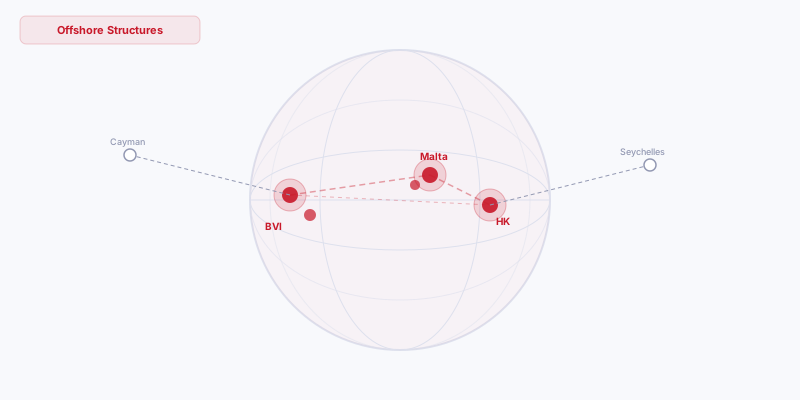
Corporate restructuring within offshore groups — whether driven by a sale process, operational simplification, regulatory change, or banking access requirements — involves a complex interplay of tax, legal, and banking considerations that must be addressed in a coordinated sequence. The tax consequences of moving assets or subsidiaries between jurisdictions, the CRS reporting implications of changing an entity's tax residency, the impact on banking relationships when entity names or structures change, and the need to maintain economic substance throughout a transition are all material concerns that a poorly planned restructuring can get badly wrong. This guide addresses the practical dimensions of offshore group restructuring as they arise in 2026.
Tax Neutrality in Group Restructurings
The fundamental objective of most internal group restructurings is tax neutrality — restructuring the group without triggering a taxable disposal at the level of either the transferring entity or the beneficial owners. The mechanisms for achieving tax neutrality vary by jurisdiction. In the UK, the Taxation of Chargeable Gains Act 1992 (TCGA) group relief provisions (sections 171-181) allow assets to be transferred between companies in the same group at no gain/no loss, deferring the crystallisation of any embedded capital gain until the asset leaves the group. For offshore jurisdictions, the equivalent relief depends on local legislation: many offshore centres (BVI, Cayman, Bermuda) have no corporate tax, making gain neutrality straightforward, but entities with UK or EU tax nexus may trigger controlled foreign company rules or exit taxes when migrating value offshore.
The OECD's BEPS Action 6 (Preventing Treaty Abuse) and the EU Anti-Tax Avoidance Directive 1 (ATAD 1, Directive 2016/1164/EU) introduced exit taxation provisions that require member states to tax unrealised gains on assets when a company migrates its tax residence out of a member state, or transfers assets to a permanent establishment outside the member state. Article 5 of ATAD 1 requires exit tax at market value on transfer; EU member states may allow deferral of payment (minimum five years for transfers to other EU/EEA member states). This means that restructuring a group that includes EU-resident entities requires careful pre-planning of the exit tax exposure and, where deferral is available, documenting the deferral election correctly.
The Step Transaction Doctrine and Anti-Avoidance
The step transaction doctrine — applied in UK tax law through cases such as Furniss v Dawson [1984] AC 474 and the Ramsay principle — provides that a series of pre-planned steps designed to achieve a tax avoidance result will be characterised for tax purposes by reference to the composite transaction and its actual commercial effect, rather than each individual step in isolation. For offshore group restructurings, this means that a planned sequence of intra-group transfers that achieves a tax-free result by exploiting statutory reliefs in a manner not contemplated by the legislation may be recharacterised by HMRC or another tax authority.
The practical implication is that restructuring plans should be designed with genuine commercial rationale for each step, not solely tax efficiency. Where a restructuring is motivated by commercial considerations — simplifying the group structure ahead of a sale, centralising treasury functions, or responding to regulatory requirements — the step transaction risk is substantially lower than for a restructuring motivated purely by avoiding tax on an anticipated disposal. HMRC's Transactions in Securities rules (ITA 2007 sections 682-713) and the General Anti-Abuse Rule (Finance Act 2013 Part 5) provide additional grounds for challenging purely tax-motivated restructuring transactions.
Banking Continuity During Restructuring
A restructuring that changes entity names, ownership structures, or operating jurisdictions will typically require updating banking mandates, KYC records, and signatory authorities at every affected institution. Banks treat these changes as material updates that trigger re-KYC — effectively a new onboarding review for the changed entity — and the timing of these updates relative to the legal steps in the restructuring requires careful coordination. Banking mandates lapse automatically on certain triggering events (change of name, change of ownership above a threshold) under most account terms and conditions; operating under a lapsed mandate creates both legal and compliance risk.
For offshore structures undergoing restructuring, the practical sequence is: (1) notify banking partners of the planned restructuring before execution, not after; (2) prepare a complete updated KYC package reflecting the post-restructuring structure, including updated corporate documents, beneficial ownership charts, and board resolutions; (3) obtain bank confirmation that the updated KYC package is acceptable before executing the legal steps; and (4) execute the legal steps and update the banking mandates simultaneously or in close sequence. Banks that discover a material change to an entity's structure after the fact — through CRS reporting, public records, or adverse media — will take a less cooperative approach to the re-KYC process than banks that have been engaged proactively.
CRS Reporting Implications of Restructuring
Restructuring an offshore group can trigger significant CRS reporting consequences. If an entity changes its tax residency from one CRS-participating jurisdiction to another, the reporting obligation for that entity's financial accounts shifts from the old jurisdiction to the new one. If a restructuring results in a previously non-reporting structure (such as an active non-financial entity exempt from CRS passive NFE look-through) becoming a passive NFE or financial institution, new CRS reporting obligations arise for the accounts of that entity. Banks and financial institutions receiving notification of a restructuring must reassess the CRS classification of the affected entities and update their reporting accordingly.
The Mandatory Disclosure Rules (MDR) — implemented in the UK through the International Tax Enforcement (Disclosable Arrangements) Regulations 2020 and in EU member states through DAC6 (Directive 2018/822/EU) — require disclosure of cross-border arrangements meeting certain hallmarks related to tax information exchange, beneficial ownership opacity, and transfer pricing. Offshore group restructurings involving cross-border transfers, changes of tax residence, or arrangements that circumvent automatic exchange of information reporting may trigger MDR/DAC6 disclosure obligations on intermediaries (lawyers, accountants, banks) and taxpayers. Identifying and managing these disclosure obligations is a necessary step in any material offshore restructuring.
CCYFX provides specialist banking for crypto, iGaming, FX brokers, and offshore structures. UK, European & US IBANs.
Speak to Our Team