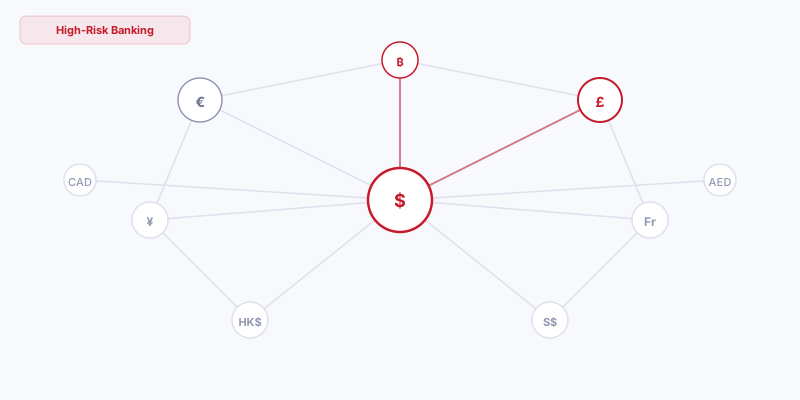
When a business in London makes a USD payment to a supplier in Singapore, the mechanics of how that payment travels — and why it costs what it costs and takes as long as it takes — are largely invisible to the sender. Those mechanics run on a system of nostro and vostro accounts that underpins virtually all cross-border banking. Understanding how this system works matters for any business that relies on international payment flows.
The Latin Etymology and What It Means
Nostro comes from the Latin for "ours." A nostro account is an account that Bank A holds at Bank B, denominated in Bank B's domestic currency. From Bank A's perspective, this is "our account held at another bank." Vostro comes from "yours." The same account, viewed from Bank B's perspective, is "your account held with us." The nostro/vostro distinction is simply a matter of which institution's perspective you are describing — the underlying account is the same.
The Architecture of International Settlement
International payments cannot simply be wired between banks the way a domestic transfer moves between two accounts at the same institution. Banks in different countries operate on different payment systems, in different currencies, under different regulatory frameworks. To move money across borders, a bank must either have a direct account relationship in the destination country and currency, or route through an intermediary that does.
A UK bank wanting to make USD payments will maintain a nostro account at a US correspondent — typically a major US clearing bank such as JPMorgan Chase, Bank of New York Mellon, or Citibank. When a UK bank customer makes a USD payment, the UK bank instructs its US correspondent to debit the nostro account and credit the beneficiary's bank (either directly or through a further correspondent). The US correspondent bank, looking at the same account, sees a vostro account — a foreign bank's USD account held with them.
The SWIFT Network and ISO 20022
Correspondent banking messaging is transmitted through the Society for Worldwide Interbank Financial Telecommunication (SWIFT) network, which connects over 11,000 financial institutions across more than 200 countries. SWIFT does not move money — it transmits payment instructions. The actual settlement occurs through the debit and credit of nostro/vostro balances.
From November 2022, SWIFT began migrating its core messaging standard from MT (Message Type) format to ISO 20022, a richer data standard that enables more structured payment information. Full migration is scheduled for completion by November 2025, though full adoption across all correspondent relationships will take longer. ISO 20022 is significant because it allows much more granular data to accompany a payment — purpose codes, LEI identifiers, structured remittance information — which improves straight-through processing rates and reduces the manual investigations that delay cross-border payments.
Chain Payments and Intermediary Banks
Many international payments travel through more than two banks. If the sending bank does not have a direct correspondent relationship with the receiving bank's home currency, the payment routes through one or more intermediary correspondents. Each intermediary adds a processing fee, and each hop can introduce a day's delay if the intermediary requires same-day notification before settling.
A payment from a small bank in Eastern Europe to a bank in Southeast Asia might travel: sending bank → European correspondent → US clearing bank → regional Asian correspondent → receiving bank. Each step involves SWIFT messaging, nostro balance adjustment, and a fee that may or may not be disclosed upfront to the originator. The SWIFT gpi (Global Payments Innovation) initiative, now covering the majority of SWIFT cross-border transactions, has improved transparency significantly by providing end-to-end tracking and confirming the same-day crediting of beneficiaries.
Nostro Account Management
Managing nostro accounts is a significant operational function for any bank with international payment flows. Each nostro account holds an idle balance — liquidity parked at the correspondent in the foreign currency, waiting to be used for payment instructions. This balance earns a return (or incurs a negative rate in low/negative interest rate environments) and must be sized to accommodate expected daily payment flows without being so large that it represents an opportunity cost.
Nostro account reconciliation — matching the bank's internal records of payments sent and received against the actual entries on the nostro account statement — is performed daily by treasury operations teams. Unreconciled items represent either payments in transit, processing errors, or potential fraud. For high-volume payment institutions, nostro reconciliation is an industrial-scale process supported by dedicated software.
De-Risking and the Shrinking Correspondent Network
The global correspondent banking network has contracted significantly since 2012. A combination of escalating compliance costs, rising penalty risk from regulators (particularly US authorities enforcing OFAC sanctions and Bank Secrecy Act requirements), and declining profitability of correspondent relationships has led major US and European clearing banks to terminate nostro/vostro relationships with thousands of respondent banks.
The World Bank and IMF have documented this contraction extensively. The impact falls disproportionately on smaller banks in developing countries, small island jurisdictions, and institutions serving sectors perceived as high-risk. When a bank loses its USD correspondent, its customers lose the ability to make or receive dollar payments — effectively cutting them off from the global financial system.
For businesses in high-risk sectors, this de-risking manifests as banks being unable to process certain payments because their correspondent will not pass them through, leading to inexplicable payment failures that the sending bank cannot resolve. Specialist payment institutions with direct scheme memberships and diversified correspondent relationships are better positioned to route around these chokepoints.
CCYFX provides specialist banking infrastructure for iGaming, crypto, FX brokers, and offshore structures. UK, European & US IBANs.
Speak to Our Team