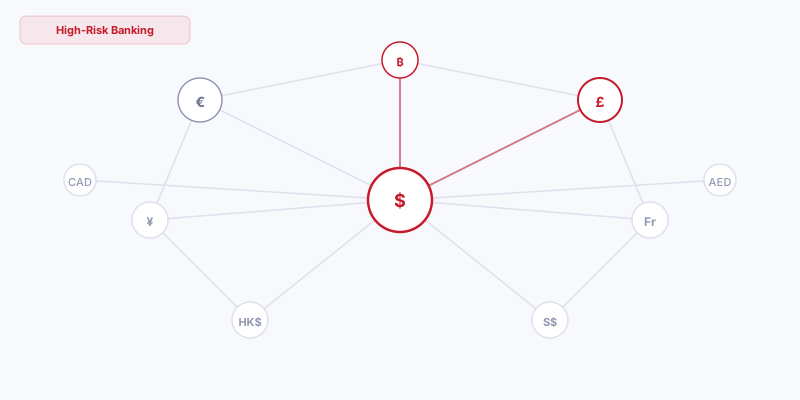
Crypto exchanges — whether spot, derivatives, or OTC — face a banking environment that is simultaneously more receptive and more demanding than it was five years ago. More receptive because the regulatory infrastructure for crypto has matured: FCA crypto asset registration, MiCA in the EU, and FATF's updated Recommendation 15 guidance on VASPs have provided a compliance framework that specialist payment firms can assess. More demanding because the failures of 2022-2023 — FTX, Celsius, Voyager, the Silvergate and Signature bank collapses — have made the surviving banking infrastructure more cautious about crypto exchange exposure and more rigorous in their due diligence requirements. Navigating this environment successfully requires a clear understanding of what banks and EMIs need to see, and how to structure fiat infrastructure around the exchange's specific operations.
The Regulatory Baseline: FCA Registration
For UK-based crypto exchanges, FCA registration under the Money Laundering Regulations 2017 (which brings crypto asset exchange activity and custody under the AML supervisory perimeter) is the essential prerequisite for banking access with reputable UK payment providers. The FCA's VASP registration process has been rigorous — as of 2026, fewer than 50 firms hold FCA crypto asset registration — and a registration certificate signals that the exchange has cleared a meaningful regulatory bar covering AML/CTF framework quality, beneficial ownership transparency, and governance.
For exchanges operating under MiCA in the EU (applicable from December 2024 for crypto asset service providers including exchanges), a MiCA authorisation from an EU member state competent authority provides the EU-equivalent signal. ESMA and national regulators have been operationalising MiCA authorisation throughout 2025 and into 2026; exchanges operating in the EU market should be pursuing MiCA authorisation through a suitable member state jurisdiction (France via AMF, Germany via BaFin, Ireland via CBI, and Malta via MFSA have been popular choices).
The Documentation Package
When approaching a specialist EMI for exchange banking, the documentation package should be comprehensive and pre-organised rather than delivered piecemeal. Core documents include: FCA crypto asset registration certificate (or equivalent MiCA authorisation); corporate KYB documents (certificate of incorporation, M&A, director and shareholder register); UBO identification to natural person level with certified identity documents; the exchange's AML/CTF policy specific to VASP activity; Travel Rule compliance documentation — the exchange's implementation of FATF Recommendation 16 using a platform such as Notabene, Sygna, or Chainalysis Route; blockchain analytics capability evidence (Chainalysis KYT, Elliptic, or equivalent for transaction monitoring of on-chain activity); audited accounts or management accounts demonstrating financial stability; and a detailed transaction flow diagram showing how fiat and crypto flows move through the exchange's accounts.
The transaction flow diagram is particularly important for exchange banking relationships. The EMI needs to understand: what currencies and payment methods deposit fiat to the exchange; how customer segregation of fiat balances is maintained; how crypto-to-fiat conversions are settled; and how customer withdrawals flow from the exchange back to customer bank accounts. Any opacity in this flow is a compliance red flag — exchanges that can provide a clear, documented transaction flow typically onboard faster and with fewer information requests.
Account Structure for Exchanges
A well-structured exchange banking infrastructure typically involves separate accounts for different functional purposes rather than a single operational account for all flows. Separating customer fiat deposits (held in a segregated or identifiable account) from the exchange's own operational funds (settlement costs, staff, infrastructure) reduces commingling risk and makes compliance demonstrably cleaner. Some specialist EMIs will structure exchange accounts specifically to facilitate this separation — customer float accounts versus operational accounts — and exchanges should discuss account architecture with prospective banking providers during the onboarding process rather than retrofitting it later.
Multiple Providers: Essential Resilience
Single-provider dependency is the most significant operational risk for crypto exchanges in the current environment. The Silvergate and Signature bank failures in March 2023 demonstrated that even banking providers specifically designed to serve the crypto sector can fail rapidly, leaving exchanges unable to process fiat deposits or withdrawals for days or weeks. UK and EU crypto exchanges whose operational fiat flows depend entirely on a single EMI are exposed to the same concentration risk in a different regulatory context.
The minimum resilient infrastructure for a crypto exchange with meaningful fiat volume is: two operational fiat accounts in GBP (different providers); two in EUR (different providers, ideally one EU-regulated for SEPA access); and a documented continuity plan for payment routing in the event of any single account disruption. Testing the backup accounts with regular low-value transactions maintains them as genuinely active relationships rather than dormant accounts that may be closed or scrutinised when suddenly activated.
CCYFX provides specialist banking infrastructure for complex businesses. UK, European & US IBANs, FX hedging, crypto on/off ramp, and global payouts to 180+ countries.
Speak to Our Team