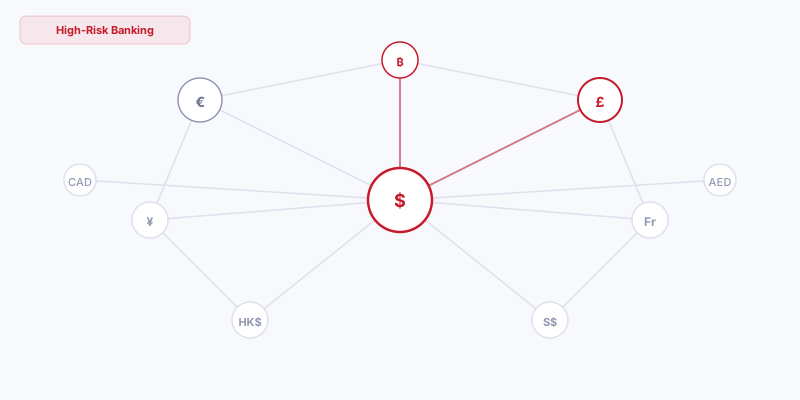
Account termination — often called debanking — is one of the most disruptive events a business can experience. The combination of immediate operational impact (incoming payments disrupted, direct debits cancelled, payroll at risk), reputational concern, and the practical difficulty of obtaining replacement banking at short notice creates a genuine crisis for many businesses. For businesses in sectors that face systematic de-risking — iGaming, crypto, FX, offshore-registered companies — account termination is not an isolated incident but a recurring risk that requires both an immediate response protocol and a long-term infrastructure strategy. This guide covers both.
Immediate Steps: The First 48 Hours
The first priority after receiving a bank account closure notice is to understand the timeline. UK banks are required under the Payment Accounts Regulations 2015 and the terms of the Financial Conduct Authority's guidance on account closure to provide a minimum notice period — typically 30 to 60 days for business accounts, though the specific contractual terms vary by bank and business account type. Review the closure notice carefully: note the effective closure date, whether incoming payments will continue to be accepted and forwarded during the notice period, and whether any explanation has been provided for the closure.
Contact your bank relationship manager (if you have one) to request a meeting to discuss the decision. Banks are not legally required to provide reasons for closing a business account in most circumstances, but in practice many will indicate at least the broad category of concern — sector policy, compliance review outcome, or a specific transaction pattern. Understanding the reason, if provided, is important for two purposes: first, it may reveal a compliance issue that needs to be addressed before approaching other providers; second, it may reveal that the closure is based on a misunderstanding that can be corrected.
The FOS Complaints Route
The Financial Ombudsman Service has jurisdiction over complaints about UK-authorised banks' decisions to close personal accounts and, in some circumstances, small business accounts (businesses with annual turnover below £6.5 million that qualify as eligible complainants). If your business falls within the FOS eligible complainant definition and you believe the account closure is unjust — for example, because it appears based on incorrect information or discriminatory sector policy without adequate consideration of individual circumstances — a formal FOS complaint is available after the bank's internal complaints process is exhausted.
It is important to manage expectations: the FOS process takes time (typically 3-6 months) and success rates for account closure complaints vary. The FOS is unlikely to compel a bank to reinstate an account while a complaint is pending. However, a successful FOS outcome can result in compensation for the disruption caused and, in some cases, the bank reconsidering its position. For businesses in systematically de-risked sectors, a more urgent priority is finding alternative banking infrastructure.
Finding Alternative Banking Infrastructure
FCA-authorised specialist EMIs are the primary alternative banking infrastructure for businesses in de-risked sectors. These institutions have risk appetites and compliance frameworks specifically designed for iGaming, crypto, FX, offshore, and high-risk merchant businesses. The application process typically requires: a KYB pack covering corporate documents, UBO identification, and AML compliance documentation; a description of the business model and anticipated transaction flows; and for regulated businesses, evidence of the relevant regulatory licence or registration.
When approaching specialist EMIs after a bank account closure, be transparent about the account closure and its circumstances. Attempting to conceal a recent account closure from a prospective payment provider is both ineffective (CIFAS fraud prevention checks and industry information sharing mean closures are often discoverable) and damaging to the onboarding relationship if discovered. A coherent explanation of the circumstances of the closure — particularly if the closure was sector-driven rather than compliance-failure-driven — is far better received than a disclosure failure later.
Building Resilient Infrastructure: The Long-Term Answer
The most effective response to debanking risk is to ensure that account termination by any single provider is not a business-critical event. Maintaining multiple payment relationships in parallel — at minimum two, ideally three, with different provider types (one specialist EMI, one more mainstream neobank where accessible, and a backup) — means that any single termination creates operational friction rather than existential crisis. Named IBANs in multiple jurisdictions provide additional resilience: counterparties can be instructed to use a EUR IBAN in one jurisdiction while GBP infrastructure is being rebuilt, for example.
Proactive relationship management with existing payment providers dramatically reduces termination risk. Providers that receive regular compliance updates, timely responses to information requests, and proactive notification of material business changes (new markets, new products, changes in transaction volumes) are far less likely to initiate account reviews that result in termination. Treating your payment provider relationship as a partnership — rather than a utility — is the most effective debanking prevention strategy available.
CCYFX provides specialist banking infrastructure for complex businesses. UK, European & US IBANs, FX hedging, crypto on/off ramp, and global payouts to 180+ countries.
Speak to Our Team