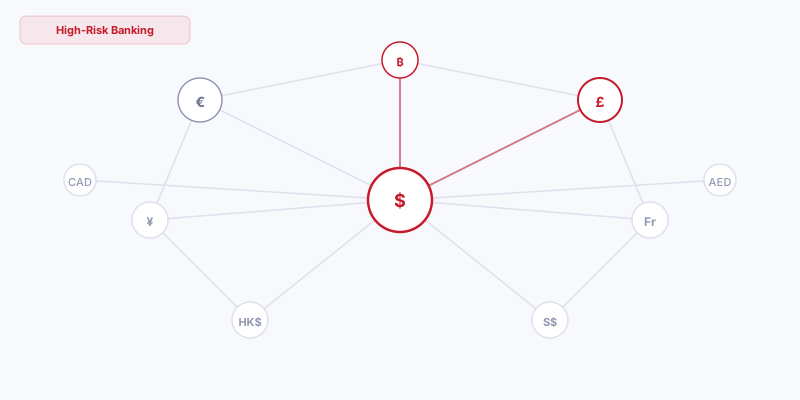
The phrase "high-risk" is one of the most consequential labels a bank can apply to a business. It can mean higher fees, months-long onboarding delays, or outright refusal to open an account. Yet the criteria banks use are rarely published, leaving businesses confused about why they have been declined and what their realistic alternatives are.
This guide sets out the industries that UK banks and regulated payment institutions consistently classify as elevated risk, explains the regulatory logic behind those classifications, and outlines what this means practically for affected businesses.
How Banks Define High-Risk
There is no single statutory list of high-risk industries in the UK. Instead, classification emerges from a combination of sources: the Financial Action Task Force (FATF) guidance on money laundering vulnerabilities, the FCA's own supervisory expectations under the Money Laundering Regulations 2017 (MLR17), Wolfsberg Group principles, and each institution's internal risk appetite — which varies considerably between a large clearing bank and a specialist EMI.
Banks typically apply a tiered framework. Sectors with the highest inherent money laundering or fraud risk receive enhanced due diligence (EDD) automatically under Regulation 33 of MLR17. Other sectors may trigger EDD based on business model characteristics: high transaction volumes, cash intensity, cross-border flows, or opacity of beneficial ownership.
The Complete High-Risk Industry List
Online Gambling and iGaming
Online casinos, sportsbooks, poker sites, and affiliated businesses are among the most consistently restricted sectors. The Gambling Commission's Licence Conditions and Codes of Practice (LCCP) require operator accounts to segregate player funds, which creates compliance obligations that many banks are unwilling to accommodate. Chargebacks, fraud, and the potential for players to launder winnings compound the risk profile.
Cryptocurrency Exchanges and Custodians
FCA-registered cryptoasset businesses under the Money Laundering, Terrorist Financing and Transfer of Funds (Information on the Payer) Regulations 2017 face systematic de-banking from high-street institutions. Despite being regulated, exchanges typically cannot open current accounts with major UK clearing banks. The concern is the perceived difficulty of tracing the origin of crypto assets and the global, pseudonymous nature of blockchain transactions.
FX Brokers and Retail CFD Providers
FCA-authorised FX and CFD brokers routinely face account restrictions. Client money handling under CASS 7 introduces complex segregation requirements, and the high-volume, multi-currency nature of operations exceeds most banks' risk tolerance for non-institutional counterparties.
Offshore and International Business Companies
BVI, Cayman, Seychelles, and similar offshore structures trigger automatic EDD under most bank policies. Even where the underlying business is entirely legitimate, the opacity associated with certain jurisdictions and the use of nominee directors or bearer structures historically associated with these domiciles means banks apply blanket restrictions.
Adult Content and Entertainment
Platforms hosting adult content, escort directories, and related services are refused by virtually all high-street banks and many EMIs. The combination of reputational risk, the potential for minors to access services, and high chargeback rates makes this sector largely unserviceable by mainstream institutions.
Cannabis, CBD, and Psychedelics
Despite CBD products being legal in the UK, their close association with controlled cannabis means most banks apply the same restrictions as they would to illegal substances. US cannabis businesses — even those operating legally under state licences — face near-universal banking refusal from UK-domiciled institutions due to the federal scheduling of cannabis.
Pawnbrokers and Consumer Lending
FCA-authorised pawnbrokers and high-cost credit lenders are classified as high-risk due to their cash-intensive operations and the vulnerability of their customer base. The FCA's Consumer Duty framework (July 2023) adds compliance complexity that increases the due diligence burden on banks.
Firearms and Weapons Dealers
Licensed arms dealers, firearms retailers, and export businesses operate legally but face routine banking restrictions. Sanctions compliance obligations, export control regulations under ECJU licensing, and reputational considerations make this sector unwilling territory for most banks.
Money Service Businesses (MSBs)
HMRC-registered MSBs — including currency exchange bureaux, hawala networks, and remittance services — are among the most affected by de-risking. Despite regulatory registration being mandatory, banks have systematically closed MSB accounts since 2012, a trend documented in the FCA's own thematic reviews.
High-Value Dealers
Businesses dealing in luxury goods, art, antiques, and jewellery that accept cash transactions of €10,000 or more must register with HMRC under the Money Laundering Regulations. This registration itself signals heightened scrutiny to banks' compliance teams.
Charities Operating in Conflict Zones
Non-profit organisations with operations in FATF high-risk or monitored jurisdictions — particularly those in the Middle East, Sub-Saharan Africa, or Central Asia — face account closures and restrictions due to the perceived risk of funds reaching sanctioned parties or terrorist organisations.
Pharmaceutical and Nutraceutical E-Commerce
Online pharmacies, supplement retailers with quasi-medical claims, and nootropics vendors face bank scepticism due to regulatory ambiguity and high chargeback rates. Businesses selling products that straddle the food supplement/medicine boundary are particularly exposed.
The Compliance Logic Behind These Classifications
Banks are not acting arbitrarily. Under MLR17 Regulation 18, they must conduct a documented risk assessment of their own business, and under Regulation 28, they must apply CDD and EDD proportionate to that risk. If a bank's compliance team cannot adequately assess the money laundering risk of a particular sector, the safest outcome under supervisory scrutiny is to decline.
The FCA has been explicit in its supervisory messages: institutions that fail to apply adequate EDD to high-risk customers face enforcement action. The perverse incentive this creates is that banks over-apply EDD — or simply refuse — rather than risk regulatory sanction for under-doing it.
What High-Risk Classification Means Practically
- Standard account opening is refused or takes 6–18 months with documentary demands that would strain any legal team
- Transaction monitoring generates frequent false positives, leading to frozen transactions and account suspensions with little notice
- Fees are typically 3–10x those charged to lower-risk businesses
- Relationship managers lack product knowledge to assess the legitimate nature of the business
- Exit clauses in terms and conditions permit closure with as little as two months' notice
The Specialist Alternative
FCA-authorised specialist payment institutions — operating under EMI or payment institution licences — are purpose-built to serve sectors that high-street banks decline. Their compliance frameworks are specifically calibrated for the risk profiles of iGaming, crypto, FX, and offshore structures. They employ compliance teams with direct sector expertise, reducing both onboarding friction and the frequency of false positives in transaction monitoring.
CCYFX maintains named IBAN infrastructure across the UK, EU and US specifically for businesses in these sectors. Our onboarding process is designed to accommodate the structural complexity — offshore holding companies, multi-currency operations, high-volume transaction flows — that standard banking cannot handle.
CCYFX provides specialist banking infrastructure for iGaming, crypto, FX brokers, and offshore structures. UK, European & US IBANs.
Speak to Our Team