Malta and Gibraltar are the two principal European iGaming licensing jurisdictions for operators targeting international markets outside the UK. Both are well-established, with decades of experience regulating online gambling businesses and a significant cluster of operators, service providers, and banking infrastructure built around their iGaming sectors. However, they differ in important respects — regulatory culture, tax framework, banking access, and EU membership status — that make one materially preferable to the other depending on the operator's specific business model, target markets, and ownership structure.
EU Membership and Payment Access
The most significant structural difference between Malta and Gibraltar is EU membership. Malta is an EU member state; Gibraltar is not, following the UK's departure from the EU. This distinction has material banking and payment implications.
A Maltese-incorporated entity holds a SEPA IBAN and can receive and send payments across the SEPA zone without cross-border friction. A German player depositing via SEPA Instant Credit Transfer to a Maltese operator receives the same payment experience as transferring between two German accounts. A Maltese EMI or bank providing payment services can passport across the EU under the Payment Services Directive (PSD2) without needing local licences in each member state.
A Gibraltar-incorporated entity does not hold EU SEPA membership through its Gibraltar banking relationships. Payments from EU players to a Gibraltar operator may be processed as cross-border payments rather than SEPA intra-zone transfers, depending on the payment rails used. Gibraltar's access to SEPA for operator banking depends on the operator using a Malta or EU-based bank or payment institution for player-facing payment accounts, even if the licensed entity itself is Gibraltar-incorporated.
Banking Access in Practice
Malta has developed a relatively well-functioning banking ecosystem for iGaming operators, though access has become more selective following MONEYVAL's assessment of Malta's AML framework in 2019 and the period of enhanced monitoring that followed. Bank of Valletta, HSBC Malta, and a number of specialist EMIs licensed in Malta provide iGaming banking services. Malta's status as an EU SEPA member means that payment institutions licensed in other EU jurisdictions can offer services to Malta-based operators through passporting, expanding the practical range of banking options.
Gibraltar's local banking sector is smaller — the main institutions are Barclays Gibraltar, HSBC Gibraltar, and a few specialist banks. Local banks have historically been comfortable with iGaming clients, as the sector is a material part of Gibraltar's economy. However, the de-risking trend has affected even Gibraltar's banking market. Operators that cannot obtain or maintain local banking must rely on EU or UK payment institutions for their operational accounts, using Gibraltar banking relationships only for the minimum required to demonstrate local economic substance.
Regulatory Culture and Enforcement Approach
The MGA and GGC have different regulatory cultures that affect the day-to-day compliance burden and the risk of regulatory action.
The MGA has invested significantly in its regulatory framework since 2018 and has become one of the world's more sophisticated remote gambling regulators. Its enforcement activity has increased — operators face detailed compliance reviews, data requests, and in some cases significant fines for AML, player protection, and responsible gambling failures. The MGA has also introduced a progressive approach to technology regulation, with its sandbox for distributed ledger technology and blockchain gaming being among the first in the world.
The GGC operates with a smaller team and a lighter touch on day-to-day compliance monitoring. It has historically been more consultative in its regulatory approach — operators report that the GGC is accessible and pragmatic in its engagement with licensees. Gibraltar's smaller regulatory community means that informal dialogue with the regulator is more readily available to operators than in Malta's larger and more bureaucratic framework.
Tax Comparison
Malta: Gaming Tax at 5% on first €3m GGR, reducing to 3% above; corporate income tax at 35% with imputation refund reducing effective rate for qualifying structures; no gaming withholding tax on player winnings.
Gibraltar: Gaming Duty at 0.15% of GGY, capped at £425,000 per licence; corporate income tax at 10% on Gibraltar-source profits; no VAT on gambling services. For large operators, the duty cap creates an extremely low effective gaming tax rate.
For operators with significant GGR, Gibraltar's duty cap creates a materially lower gaming tax burden than Malta's GGR-based rate. For smaller operators, Malta's absolute amounts are lower. The corporate tax differential favours Gibraltar in all cases where the operator has genuine Gibraltar substance and its profits are genuinely Gibraltar-source.
Recommendation Framework
Malta is the preferred choice for: operators targeting European regulated markets who need SEPA payment access and EU regulatory recognition; operators for whom MGA brand recognition is important in European-facing B2C products; and operators who expect to passport payment services from their Maltese entity across the EU.
Gibraltar is the preferred choice for: large operators for whom the gaming duty cap delivers material cost savings; operators primarily targeting non-EU international markets where EU membership is less relevant to market access; and operators whose ownership structure can benefit from Gibraltar's 10% corporate tax rate on a genuine substance basis.
Many major operators hold licences in both jurisdictions — a Malta licence for EU market access and payment infrastructure, and a Gibraltar licence for the corporate structure housing international revenue. The banking infrastructure for this dual-jurisdiction model must maintain separate player fund accounts per regulatory perimeter and support clean attribution of revenue and costs between the two licensed entities.
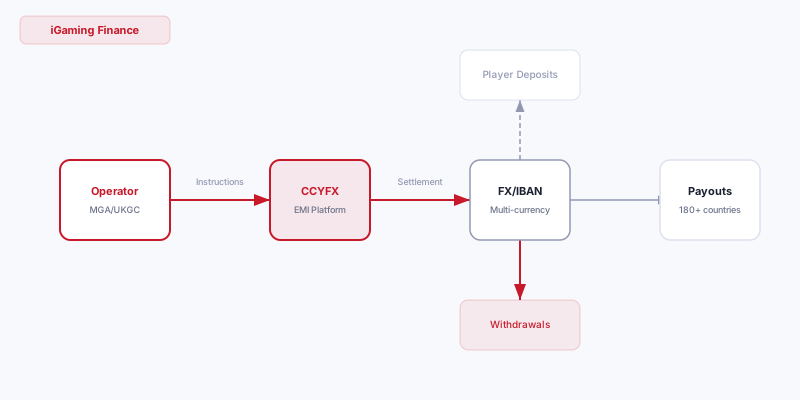
CCYFX provides specialist banking infrastructure for iGaming, crypto, FX brokers, and offshore structures. UK, European & US IBANs.
Speak to Our Team