Treasury management for an iGaming operator is materially more complex than for most commercial businesses. The combination of player liability management, multi-licence regulatory capital requirements, high-volume multi-currency payment flows, and the inherent unpredictability of gaming revenue creates a treasury challenge that demands a disciplined, systematic approach. This guide sets out the best practice framework for iGaming treasury operations.
The Three Treasury Pools
The starting point for iGaming treasury is recognising that the operator's cash does not form a single undifferentiated pool. It comprises three distinct pools, each with its own regulatory requirements, investment constraints, and operational characteristics:
Pool 1: Player Fund Liability
The player fund represents the aggregate balance of all player wallets — the sum of all deposits that players have made but not yet wagered or withdrawn. Under the UKGC's Licence Conditions, this balance must be held in a segregated account that cannot be used to meet the operator's own liabilities. The account must be reconciled daily against the aggregate player wallet balance maintained in the gaming platform.
The player fund pool has a specific investment constraint: it must be held in a form that is immediately available to return to players if the operator ceases trading. Cash in a segregated account at a regulated institution is the standard approach. Investing player funds in anything less liquid — money market funds, short-dated gilts — is possible under some regulatory frameworks but requires regulatory approval and introduces counterparty risk to what should be the most protected pool.
Pool 2: Operational Working Capital
The operational pool comprises the operator's own funds — the difference between gross deposits received and the player fund liability — plus the float held in payment accounts to fund outbound withdrawals and supplier payments. This pool funds the day-to-day operations: technology costs, staffing, marketing, licensing fees, and affiliate commissions.
The operational pool should maintain sufficient float to cover two to three days of expected outbound payments without needing to draw from the player fund or request emergency funding. Float modelling — based on historical payment velocity with appropriate buffer for peak periods — should be reviewed monthly and updated when the business changes scale materially.
Pool 3: Regulatory Capital
Where the operator holds multiple licences, each regulator will specify minimum capital requirements. The UKGC does not impose a minimum own funds requirement in the same manner as a financial services regulator, but the MGA requires operators to maintain working capital commensurate with their operational needs as assessed during the licensing process. The Gibraltar Gambling Commissioner similarly assesses adequacy of capital as part of the licence review.
Multi-Currency Float Management
An operator serving UK, Swedish, German, and Norwegian players simultaneously maintains player liabilities in GBP, SEK, EUR, and NOK. Each currency requires a float sufficient to meet expected withdrawal demand in that currency on any given day. The treasury challenge is balancing these floats without maintaining excessive idle cash in low-demand currencies.
The optimal approach is a centralised conversion model: the operator maintains a large primary currency position (typically EUR or GBP) and converts to subsidiary currencies on a just-in-time basis as withdrawal demand materialises. This requires a payment partner with real-time FX conversion capability — the conversion from EUR to NOK at the point of withdrawal must be instantaneous and at a rate locked at the time the withdrawal is approved, not at the time the payment settles.
FX Exposure Management
The operator's P&L contains two types of FX exposure that require different management approaches:
Operational FX exposure: the net position between revenue received in non-functional currencies and costs incurred in non-functional currencies. A GBP-functional operator receiving EUR revenue and paying EUR game content royalties has a natural net EUR exposure that should be modelled monthly and hedged to the extent that it is predictable.
Player fund translation risk: the FX revaluation of player fund balances denominated in non-functional currencies when restated into the functional currency for financial reporting. This risk is best eliminated by operating the player fund in the functional currency — converting foreign currency deposits at point of receipt so the liability is recorded in the functional currency throughout its life.
Daily Treasury Operations
A well-run iGaming treasury function performs the following daily tasks:
- Player fund reconciliation: confirming that the segregated account balance equals or exceeds the aggregate player wallet balance as of the prior day end
- Operational float review: confirming that each currency withdrawal account maintains its target float level and initiating replenishment transfers where buffers have been drawn down
- FX position report: reviewing the net currency exposure across all operational accounts and comparing to the hedging policy limits
- Inbound settlement confirmation: confirming that acquirer settlements from the previous business day have been received as expected, investigating any shortfalls
- Affiliate and supplier payment batch review: confirming that the day's scheduled batch payments are correctly funded and within AML screening parameters
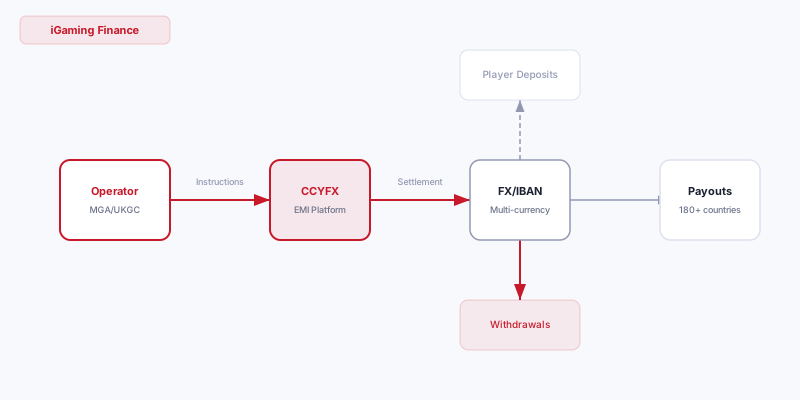
CCYFX provides the payment infrastructure layer for iGaming treasury operations: named IBANs for player fund segregation and operational accounts, multi-currency FX conversion, and batch payout capability with API integration to gaming platform back-offices.
CCYFX provides specialist banking infrastructure for iGaming, crypto, FX brokers, and offshore structures. UK, European & US IBANs.
Speak to Our Team