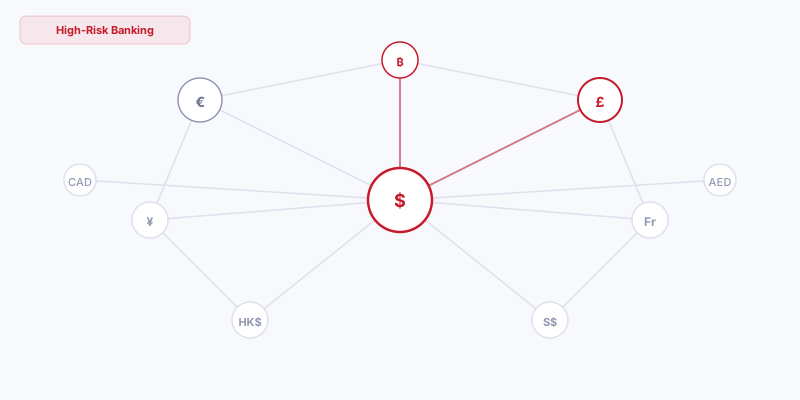
An offshore group with operating subsidiaries in Malta and Gibraltar, a holding company in the BVI, a treasury vehicle in Luxembourg, and customers in twenty countries is not an unusual structure in iGaming or fintech. But managing treasury across this architecture — ensuring each entity has the liquidity it needs, that FX exposure is consolidated rather than fragmented, and that intercompany flows are properly documented — requires infrastructure and strategy that most finance teams are not initially equipped to handle.
The Core Problem: Fragmented Liquidity
The most common treasury failure in multi-jurisdiction groups is fragmented liquidity. Each entity accumulates cash in its operating currency — the Malta subsidiary has EUR, the Gibraltar entity has GBP, the BVI holding company has USD — and these pools are managed locally without consolidation. The result is that the group simultaneously has cash surpluses in some entities and cash deficits in others, with value being destroyed in the form of both idle surplus balances and expensive intercompany lending to cover deficits.
The solution is a treasury centralisation model, but implementation depends heavily on the banking infrastructure available to each entity in the group.
In-House Banking and Notional Pooling
The gold standard for multi-entity treasury is an in-house banking structure where a central treasury entity — often the group holding company or a dedicated treasury SPV — acts as the internal bank for all operating subsidiaries. Operating entities fund themselves by drawing on the central treasury, and cash surpluses are upstreamed to the centre daily.
At a technical level, this can be implemented through two mechanisms: physical cash pooling (actual cash sweeps, where balances are physically consolidated into a master account daily) or notional pooling (balances remain in place but the bank provides interest calculations as if they were consolidated, with overdrafts in some entities offset against surpluses in others).
For offshore groups, the challenge is that notional pooling requires the pooling bank to have accounts in all the relevant jurisdictions and to be willing to provide the product across those jurisdictions. This is precisely the type of cross-border, multi-entity arrangement that mainstream banks are reluctant to offer to groups with offshore holding structures.
The Specialist Payment Institution Alternative
Where traditional pooling is unavailable, a specialist payment institution with multi-currency account infrastructure can replicate many of the same benefits. By establishing named IBAN accounts for each entity in the relevant currencies, and using the payment institution's internal book transfer capability to move funds between entity accounts, a group can achieve effective centralisation without requiring a traditional bank to provide pooling across its corporate tree.
Internal book transfers between accounts at the same payment institution are typically instantaneous, avoid correspondent banking costs, and can be executed via API — enabling automated daily sweeps that mirror physical pooling without the banking relationship complexity. The key requirement is that the payment institution holds accounts for multiple entities within the same group and can demonstrate to its own compliance team that the intercompany transfers represent legitimate intragroup liquidity management rather than suspicious fund movement.
Intercompany Loans and Transfer Pricing
Cash movements between group entities are not simply treasury operations — they are intercompany transactions with tax and regulatory implications. Under the OECD Transfer Pricing Guidelines, intercompany lending must be priced at arm's length rates; the applicable benchmark rate is typically derived from the risk-free rate in the relevant currency plus a credit spread reflecting the borrowing entity's standalone creditworthiness.
Failure to document intercompany loans properly creates both transfer pricing risk (the tax authority in the lending entity's jurisdiction may challenge the interest rate) and banking compliance risk (unexplained large transfers between entities in different jurisdictions look like structuring to a transaction monitoring system). Every intercompany transfer of material size should be supported by an intercompany loan agreement with a documented commercial rate.
FX Consolidation Strategy
A multi-jurisdiction group accumulates FX exposures in every currency in which it has revenue or costs. Without centralisation, each subsidiary hedges (or more commonly, does not hedge) its own exposure independently, resulting in the group paying FX conversion costs multiple times on the same underlying exposure — once when revenue is earned in a foreign currency and again when it is repatriated to the functional currency of the holding company.
A centralised FX strategy begins with mapping: which currencies does the group receive revenue in, what currencies does it incur costs in, and what is the net exposure in each currency pair? Once the net exposure is understood, it can be hedged at the group level using forward contracts or options with a single FX counterparty, eliminating the duplication of cost that arises from subsidiary-level hedging and providing a more accurate picture of the group's true FX risk.
Regulatory Capital Allocation
Regulated entities within the group — MGA-licensed operators, FCA-authorised payment institutions, Gibraltar DGS licensees — have minimum capital requirements that must be maintained at the entity level. Treasury centralisation must accommodate these regulatory floors: not all of the entity's cash can be swept to the group centre, because the entity must maintain sufficient capital to satisfy its regulator.
A well-designed treasury structure will model the regulatory capital requirement of each regulated entity as a floor balance, with sweeps configured to leave that minimum in place. Any surplus above the regulatory floor can be swept; any deficit below it requires injection from the group centre. This requires daily monitoring and an automated sweep rule that references the regulatory capital threshold rather than sweeping to zero.
CCYFX provides multi-entity account infrastructure and named IBAN access in the UK, EU and US, enabling offshore groups to implement centralised treasury operations without requiring traditional bank pooling arrangements. Our compliance team is experienced in documenting intercompany transfer patterns that satisfy both AML obligations and group treasury requirements.
CCYFX provides specialist banking infrastructure for iGaming, crypto, FX brokers, and offshore structures. UK, European & US IBANs.
Speak to Our Team