The distinction between a named IBAN — a dedicated IBAN issued in your business's own name — and a pooled payment account arrangement is one of the most commercially consequential differences in specialist payment firm offerings. It affects whether your counterparties know they are paying you, how your incoming payments are received and matched, what happens to your funds if your payment provider fails, and how your payment provider relationship is perceived by your banking counterparties. For businesses in complex sectors that rely on specialist EMIs as their primary banking infrastructure, understanding this distinction is fundamental to structuring payment operations correctly.
What a Named IBAN Is
A named IBAN — sometimes called a dedicated IBAN or a virtual IBAN — is an International Bank Account Number issued specifically in your business's name. When a counterparty initiates a payment to your named IBAN, the payment message includes your company name as the account holder. The IBAN is unique to your business and does not share the account number with any other business. Incoming payments arrive directly into a balance associated exclusively with your account at the payment provider, visible in your account dashboard in real time.
In the UK, a named IBAN for GBP typically uses a dedicated sort code and account number combination issued in your company's name. For EUR, a named IBAN in the standard IBAN format (beginning with GB, DE, LT, or another jurisdiction prefix depending on where the payment provider holds its banking licence) is issued in your company's name, accessible for SEPA Credit Transfers, SEPA Instant, and SWIFT payments from international counterparties.
What a Pooled Account Is
A pooled account arrangement — common among lower-tier payment providers and some aggregated payment services — allocates a payment reference rather than a unique account number. All clients of the payment provider share the same sort code and account number (the provider's omnibus account), and incoming payments are identified by a payment reference embedded in the transaction reference field rather than by the account number itself. Your counterparty's payment message shows the payment provider's name as the account holder, not your company name.
Pooled arrangements work operationally when references are used correctly — but they create several material problems that named IBAN structures avoid entirely. Reference errors (counterparties forgetting the reference, truncating it, or using the wrong reference) result in unmatched incoming payments that require manual reconciliation. Counterparties' banks may flag or reject payments where the beneficiary name does not match an account holder (a growing issue as banks implement IBAN name verification requirements under regulations like the EU Instant Payments Regulation's IBAN-name checking mandate). And in the payment provider's insolvency, the pool of funds held in the omnibus account requires more complex tracing to identify each client's entitlement.
Counterparty Trust and Commercial Credibility
For businesses that receive payments from institutional counterparties — banks, financial institutions, corporate treasuries — a named IBAN in your company's name provides a payment instruction that is clearly identifiable and straightforward to process. Many institutional treasury systems include beneficiary name verification as part of their payment initiation controls: payments where the account name does not match the registered beneficiary may trigger manual review or rejection. A named IBAN eliminates this friction entirely — your company name matches the account holder, exactly as it would with a bank account.
For businesses in high-risk sectors — iGaming operators, FX brokers, crypto exchanges — the ability to receive payments into an account in the business's own name is particularly important for regulatory purposes. Gaming licence conditions typically require that player funds and settlement flows move through accounts in the licensee's name. Licence compliance audits and FCA supervisory reviews of payment flow documentation are significantly cleaner when the accounts are named rather than pooled-reference accounts.
Multi-Currency Named IBANs
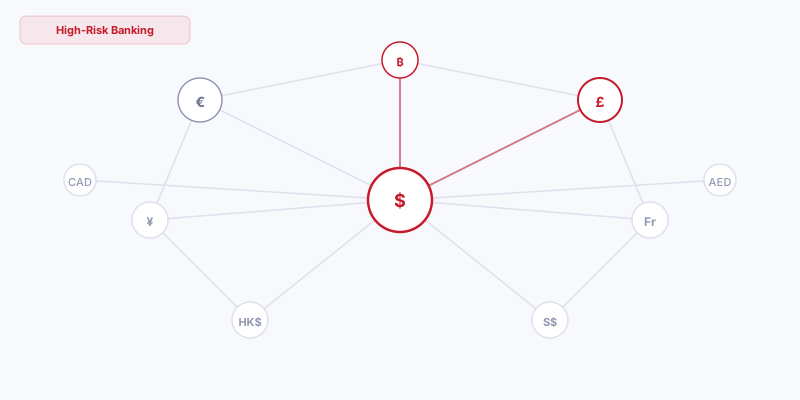
Leading specialist EMIs now offer named IBANs across multiple currencies and jurisdictions — GBP with UK sort code, EUR with SEPA access, USD accounts, and in some cases CHF, SGD, and other currencies in corresponding jurisdictions. For international businesses that need to receive and hold multiple currencies, named IBANs in each currency provide a unified account management experience with currency-specific payment rails. This multi-currency named IBAN infrastructure is the closest functional equivalent to a multi-currency bank account available through an EMI, without the access constraints that mainstream banks impose on high-risk sectors.
Reconciliation and Operational Efficiency
From a treasury management perspective, named IBANs dramatically simplify reconciliation. Every incoming payment arrives with the account directly identified — there is no reference matching required, no unmatched payment investigation, and no risk of funds arriving into the wrong account due to reference errors. For businesses processing significant inbound payment volumes — iGaming deposit flows, FX settlement receipts, B2B invoice collections — the reconciliation efficiency difference between named IBAN infrastructure and pooled accounts compounds significantly at volume. Finance teams spending hours weekly resolving pooled account reference mismatches represent a real operational cost that named IBAN infrastructure eliminates.
CCYFX provides specialist banking infrastructure for complex businesses. UK, European & US IBANs, FX hedging, crypto on/off ramp, and global payouts to 180+ countries.
Speak to Our Team