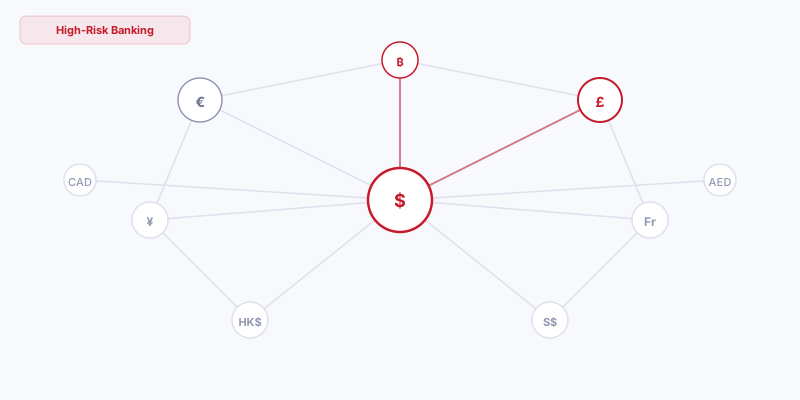
Offshore holding structures — companies incorporated in the BVI, Cayman Islands, Seychelles, Panama, or similar jurisdictions — are used legitimately by multinational businesses for genuine commercial purposes: asset protection, tax efficiency within applicable law, investment holding, and the administration of international operating groups. Obtaining and maintaining banking or payment account access for these structures has become progressively more challenging over the past decade as global AML reforms have increased scrutiny of offshore entities. Understanding what payment providers actually need — and how to present an offshore structure compliantly — makes the difference between a banking relationship and a year of account rejections.
The Compliance Landscape Offshore Structures Navigate
Under the Money Laundering Regulations 2017, UK-regulated payment firms must apply Enhanced Due Diligence to business relationships involving entities connected to high-risk third countries (Regulation 33(1)(b)) and to any relationship that by its nature presents a higher ML/TF risk (Regulation 33(3)). Offshore-registered entities fall squarely within the second category for virtually every UK-regulated payment provider. The FATF's Mutual Evaluation Reports on offshore jurisdictions, combined with the historical association of offshore structures with financial crime, means that EDD is the baseline — not an exception — for offshore holding company relationships.
This is not inherently an obstacle. The EDD framework exists to investigate and document the legitimacy of the structure, not to prohibit access. Payment firms that specialise in offshore structures have processes calibrated to efficiently assess and document the information needed to satisfy EDD requirements while providing account access to legitimate businesses.
What Payment Providers Need to See
The core of the EDD pack for an offshore holding company is the commercial rationale question: why is this entity incorporated offshore rather than in the operating jurisdiction? This question is not hostile — it is the central AML risk indicator. A Cayman Islands holding company that sits above a group of UAE-licensed FX trading subsidiaries and holds the group's investment portfolio has a coherent commercial rationale. A BVI company that appears to conduct no discernible business activity, has nominee directors, and receives unexplained fund transfers from multiple jurisdictions does not. The payment provider's job is to assess the former as manageable and decline the latter.
Documentation that supports a coherent commercial rationale includes: the corporate structure diagram showing all entities in the group and the offshore entity's role in the structure; the constitutional documents (certificate of incorporation, M&A, register of directors and shareholders); UBO identification to the natural person level with certified identity documentation; evidence of economic substance in the offshore jurisdiction where applicable (for Cayman and BVI, substance compliance under the respective economic substance frameworks has been mandatory since 2019); and source of wealth documentation for all UBOs — not self-certification, but substantive documentary evidence of how the UBO wealth was generated.
The Nominee Director Problem
Nominee director arrangements remain common in offshore structures, particularly BVI and Seychelles companies. From a payment firm's perspective, a nominee director arrangement that obscures the real management and control of the entity is a significant EDD concern. Regulation 28 of MLR 2017 requires identification of any person purporting to act on behalf of a customer — which includes nominee directors acting in that capacity. Where nominees are in place, the payment firm will need to understand and document the identity of the actual principals who give instructions to the nominees, and satisfy itself that the nominee arrangement is a genuine structural choice rather than a mechanism to conceal the real controllers.
Offshore structures with nominees can still access banking — but the documentation burden is heavier and the senior management approval requirement under Regulation 33(5) (for high-risk third country connections) adds an additional internal governance step. Businesses using nominee arrangements should factor in longer onboarding timelines and should proactively provide detailed information about the nominee arrangement's purpose and the identity of the real controllers rather than waiting for the payment firm to request it.
Structuring for Banking Access
Offshore holding companies with genuine commercial purposes can maximise their banking access prospects by: maintaining proper substance in the offshore jurisdiction (board meetings with minutes, director decisions, economic substance compliance filings); keeping UBO records current and accessible; maintaining audited accounts at the holding company level, not just at subsidiary level; avoiding complex chains of offshore entities where one onshore entity could serve the same purpose; and being transparent with payment providers about the structure from the outset. The businesses that struggle most with offshore banking access are those that present documents only reactively, cannot articulate why each structural layer exists, and resist UBO disclosure rather than embracing it as a standard compliance requirement in 2026.
CCYFX provides specialist banking infrastructure for complex businesses. UK, European & US IBANs, FX hedging, crypto on/off ramp, and global payouts to 180+ countries.
Speak to Our Team