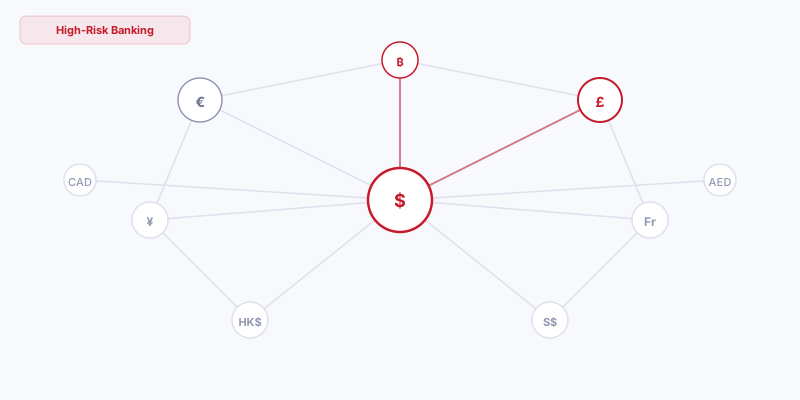
Offshore structures are legitimate, widely used, and endorsed by some of the world's largest law firms and corporate service providers. Yet the businesses that use them — holding companies in the British Virgin Islands, trading entities in the Cayman Islands, international business companies in Seychelles — face a banking landscape that has become progressively more hostile since 2012. Understanding why this has happened, and what the practical alternatives are, is essential for any offshore group that needs to function operationally.
The Regulatory Shift That Changed Offshore Banking
The watershed moment for offshore banking access was the Financial Action Task Force's (FATF) 2012 Recommendations, which fundamentally reoriented global AML frameworks toward beneficial ownership transparency. In the years that followed, correspondent banks — the major US and European institutions that process dollar and euro clearing globally — began systematically severing relationships with financial institutions in jurisdictions that appeared on adverse lists or that processed offshore company transactions.
This process of de-risking gathered pace with the OECD's Common Reporting Standard (CRS), implemented from 2017, which required financial institutions to report account information for non-resident beneficial owners to their home tax authorities. The combination of CRS and FATF pressure made many banks decide that offshore company customers simply were not worth the compliance overhead, regardless of the legitimacy of the underlying business.
Why BVI Companies Face Particular Difficulty
The British Virgin Islands is home to approximately 400,000 active business companies. The BVI Business Companies Act 2004 provides a flexible and credible corporate framework, and BVI entities are used legitimately by multinational groups, private equity funds, joint ventures, and individual investors worldwide. Despite this, BVI companies routinely find themselves unable to open accounts with UK clearing banks.
The core issue is the historical association between BVI companies and beneficial ownership opacity. Before the BVI introduced its beneficial ownership register — maintained privately by the British Virgin Islands Financial Investigation Agency under the Beneficial Ownership Secure Search (BOSS) system — it was impossible for a bank to verify who ultimately owned a BVI entity without extensive legal investigation. That history, combined with the exposure of numerous BVI-domiciled shell companies in the Panama Papers and other leaks, has led most UK banks to treat all BVI entities as maximum risk by default.
The BVI is not on the FATF grey list, and it has implemented substantial regulatory reforms, but bank risk policies typically lag regulatory reality by years.
Cayman Islands: Fund Structures and the EDD Burden
Cayman Islands entities — including exempted companies, limited partnerships, and Cayman-domiciled funds — operate under the supervision of the Cayman Islands Monetary Authority (CIMA). CIMA is a respected regulator, and Cayman-domiciled funds must appoint registered directors and auditors and comply with the Cayman Islands Private Funds Act 2020 or the Mutual Funds Act (as revised) where applicable.
Despite this regulatory infrastructure, Cayman entities trigger automatic enhanced due diligence at virtually every UK and European bank. The EDD process requires documentation of the entity's beneficial owners through to the ultimate individual level, source of funds analysis for the capital held in the structure, and often a legal opinion from a Cayman-qualified attorney confirming the entity's legal status. This process can take six to twelve months at a bank that is willing to undertake it — and most are not.
Seychelles IBCs: The Most Restricted Jurisdiction
Seychelles International Business Companies (IBCs), incorporated under the International Business Companies Act 1994, face the most severe banking restrictions of the three major offshore jurisdictions. The Seychelles' historical listing on various EU and FATF adverse lists — it was placed on the FATF grey list in 2024 — has resulted in correspondent banks applying blanket prohibitions on accounts for Seychelles-domiciled entities.
This is particularly problematic for businesses that chose Seychelles for its speed and cost of incorporation — typically 24–48 hours at very low cost — without anticipating the downstream banking consequences. A Seychelles IBC can be incorporated within a day; finding banking for it may prove impossible with mainstream institutions.
The Substance Requirements Dimension
Overlaying all of this is the growing economic substance requirement across offshore jurisdictions. The BVI Economic Substance Act 2018, the Cayman Islands International Tax Co-operation (Economic Substance) Act 2018, and equivalent Seychelles legislation require companies carrying out certain activities — including holding company, finance and leasing, fund management, and intellectual property activities — to demonstrate genuine economic substance in the jurisdiction. Banks increasingly require evidence of substance compliance as part of their EDD process, adding another layer of documentation to an already demanding onboarding requirement.
Practical Solutions for Offshore Groups
The most effective solution for offshore structures that need operational banking is engagement with a specialist payment institution that has built its onboarding framework specifically for these entity types. Such institutions will have pre-existing relationships with corporate service providers in the relevant jurisdictions and will understand the documentation norms — apostilled certificates of incorporation, registers of directors and members, memoranda and articles, BOSS system printouts for BVI entities, CIMA registered fund certificates for Cayman — without requiring the client to educate their compliance team.
CCYFX maintains onboarding frameworks for BVI, Cayman, and Seychelles entities built around the specific documentation requirements of each jurisdiction. Our named IBAN infrastructure in the UK, EU and US means that a BVI holding company can receive and send payments with a named account that counterparties recognise, without requiring a separate bank account in each jurisdiction. The typical onboarding timeline for a well-documented offshore entity at CCYFX is two to four weeks — compared with months or outright refusal at a high-street bank.
CCYFX provides specialist banking infrastructure for iGaming, crypto, FX brokers, and offshore structures. UK, European & US IBANs.
Speak to Our Team