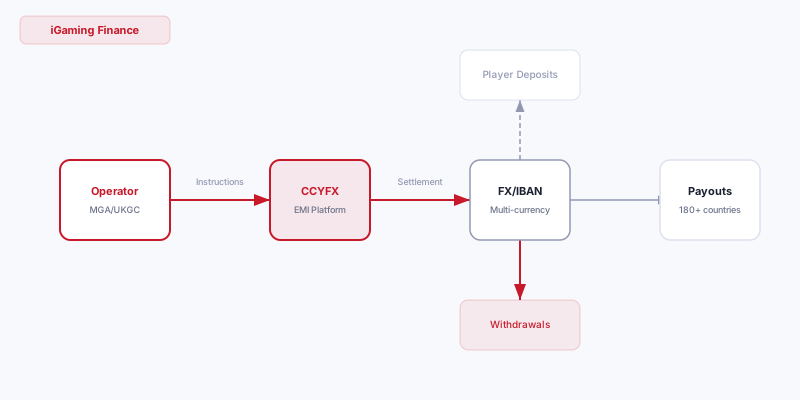
Casino operators — whether online-only, land-based with digital channels, or hybrid — share a set of banking infrastructure requirements that are more demanding than those of most other consumer businesses. High transaction volumes, real-time withdrawal expectations, multi-currency player bases, regulatory capital requirements across multiple licences, and the AML profile of gaming businesses combine to create a treasury challenge that requires deliberate infrastructure design.
Online Casino vs Land-Based: Different Infrastructure Needs
While online and land-based casinos share regulatory oversight and many operational commonalities, their banking infrastructure needs differ significantly.
Online casinos process all financial transactions electronically. Every deposit is a payment instruction from a player's debit card, bank account, or e-wallet; every withdrawal is an electronic transfer to the same. The payment infrastructure must handle thousands of transactions daily with minimal latency, automated compliance checks, and integration with the platform's real-time player account management system.
Land-based casinos handle a large volume of cash — from chips purchased at the cage to cash jackpot payments on slots — in addition to electronic payments. The cash management infrastructure (cash handling procedures, safe management, cash-in-transit arrangements, cash lodgement accounts) must be documented comprehensively for the casino's banking partner. The Gambling Commission's Licensing Conditions and Codes of Practice (LCCP) for premises licences include specific requirements on cash management and AML procedures for cash transactions above £2,000 in a 24-hour period.
Account Structure for Casino Operators
A well-structured casino banking setup involves a minimum of four account types:
1. Player Fund Segregation Account
Required by the UKGC under Licence Condition 4.2.1. This account holds all player balances — deposits pending wagering and winnings pending withdrawal. It must be clearly designated as a customer funds account and protected from the operator's own creditors. The account provider must confirm in writing that the funds are not subject to set-off against the operator's liabilities to the institution.
2. Operational Revenue Account
The operator's own funds — gross gaming revenue after removing the player fund liability. From this account, the operator meets its own costs: technology, marketing, staffing, regulatory fees, and distributions to shareholders. This account should be clearly separated from the player fund account and should reflect only the operator's own funds.
3. Withdrawal Float Account
A pre-funded account from which player withdrawals are paid. Maintaining a dedicated withdrawal float account — rather than paying withdrawals directly from the operational revenue account — simplifies reconciliation and ensures that the float specifically allocated to player payouts is always visible and managed. The float level should be maintained at a multiple of daily average withdrawal volume.
4. Bonus Liability Reserve
Where the operator runs significant bonus programmes — free spins, matched deposits, loyalty rewards — maintaining a separate reserve account for bonus liabilities improves financial transparency and helps the compliance team demonstrate that bonus payments are adequately funded. This is not a regulatory requirement in all jurisdictions but is best practice for operators with large bonus exposure.
Multi-Currency Casino Operations
Online casinos serving multiple European markets typically run player wallets in multiple currencies. The currency of a player's account matches the currency of their jurisdiction — GBP for UK players, EUR for German and Spanish players, SEK for Swedish players, and so on. The casino's platform maintains separate wallet ledgers in each currency.
The banking infrastructure must reflect this multi-currency architecture. Each currency in which the casino maintains player liabilities should have a corresponding entry in the player fund segregation account — or the account provider must be capable of maintaining sub-ledger currency balances within a single segregation account structure with full per-currency reconciliation.
FX conversion for non-functional-currency players must be handled at a competitive rate. A UK-based casino operator with a GBP functional currency paying EUR winnings to German players needs to convert EUR to GBP efficiently as the funds are repatriated from the EUR player fund to the GBP operational account. Doing this at poor FX rates is a direct P&L cost.
Land-Based Casino AML Requirements
Land-based casinos are among the highest-risk businesses for AML under FATF guidance, due to the large amounts of cash that can pass through the casino floor and the potential for criminals to convert illicit cash into gaming chips and then cash out winnings as apparently legitimate funds. The Gambling Commission's Industry Good Practice Guidance on AML is extensive, covering customer due diligence triggers, PEP and sanctions screening, transaction monitoring thresholds, and record keeping.
Banking for land-based casinos specifically requires: a cash lodgement account that the operator's bank understands is receiving cash from licensed premises; a documented cash acceptance policy setting out the limits and CDD requirements for cash transactions; and integration with the casino's AML transaction monitoring system so that high-value cash transactions are cross-referenced against the customer due diligence file.
CCYFX provides banking infrastructure for online casino operators, with player fund segregation accounts, operational revenue accounts, multi-currency FX conversion, and batch withdrawal processing.
CCYFX provides specialist banking infrastructure for iGaming, crypto, FX brokers, and offshore structures. UK, European & US IBANs.
Speak to Our Team