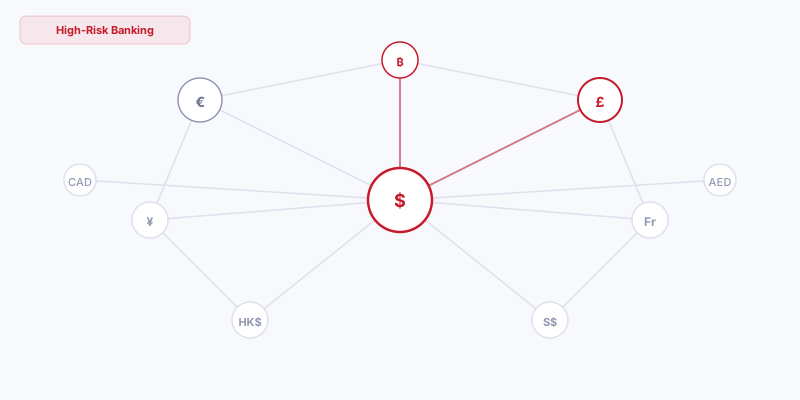
The banking access problem for crypto businesses is one of the most persistent structural challenges in the industry. Exchanges, brokers, OTC desks, custodians, and blockchain analytics firms all face systematic refusals from mainstream banks — not because of individual compliance failures, but because of blanket sector-level de-risking policies applied regardless of the individual firm's regulatory status, AML framework, or compliance quality. Understanding why banks take this position, and what the viable alternatives are in 2026, is the starting point for any crypto business building its payment infrastructure.
Why Banks Refuse Crypto Business Accounts
Mainstream UK clearing banks — Barclays, NatWest, HSBC, Lloyds — have applied restrictive policies toward crypto-related businesses for most of the last decade. The core reasons are regulatory, reputational, and economic. From a regulatory perspective, crypto businesses present compliance complexity that is disproportionate to the revenue a commercial banking relationship generates: the need to understand blockchain transaction flows, the absence of universal Travel Rule compliance until recently, the high proportion of high-risk jurisdictions in crypto counterparty networks, and the requirement to monitor for complex layering through multiple blockchain hops. These factors require specialist compliance infrastructure that mainstream banks have not built.
The reputational dimension is significant. Following the FTX collapse in November 2022, Silvergate Bank's failure in March 2023, and the closure of Signature Bank, the association between banking exposure to crypto and institutional reputational damage has made mainstream bank boards extremely cautious about crypto sector onboarding. The FCA's decision to register only a small proportion of FCA crypto asset registration applicants — as of early 2026, fewer than 50 firms hold FCA crypto asset registration — reflects the genuine compliance challenges in the sector, and banks are aware of the high proportion of unregistered or inadequately compliant firms.
The FCA Registration Threshold
A key factor in banking access for crypto businesses is FCA registration under the Money Laundering Regulations 2017. Crypto asset businesses carrying on exchange activity, custody, or certain other crypto activities in the UK must be registered with the FCA. Registration is not a light-touch process — the FCA assesses the firm's AML framework, its beneficial ownership transparency, its governance, and its compliance with FATF Recommendations including the Travel Rule. An FCA-registered crypto business has cleared a meaningful compliance bar, and this registration significantly improves (though does not guarantee) banking access with specialist EMIs.
For FCA-registered firms, the relevant documentation package for a specialist payment firm will include: the FCA registration certificate; the firm's AML policy specific to crypto asset activity; evidence of Travel Rule compliance (FATF Recommendation 16 requires originator and beneficiary information to accompany virtual asset transfers above threshold — implementation via platforms such as Notabene or Sygna is typically expected); blockchain analytics capability (Chainalysis KYT, Elliptic, or equivalent for screening incoming crypto flows); and audited accounts or management accounts demonstrating financial stability.
Specialist EMIs: The Practical Banking Infrastructure
FCA-authorised specialist EMIs with a risk appetite for crypto businesses are the realistic banking infrastructure for most UK and European crypto firms. These institutions have built compliance frameworks calibrated to the specific risks of crypto — they understand blockchain analytics outputs, Travel Rule compliance requirements, and the transaction monitoring considerations relevant to crypto-to-fiat conversion flows. Named IBANs in GBP and EUR allow crypto businesses to receive fiat from clients and counterparties, settle OTC trades, and pay operational expenses without the transaction disruption that comes from relying on pooled payment accounts that crypto businesses frequently find suspended without notice.
The practical infrastructure for a crypto exchange or OTC desk in 2026 typically involves: an FCA-authorised EMI for GBP receipts and payments (Faster Payments, CHAPS); a SEPA-enabled EMI for EUR flows; custody infrastructure separate from payment infrastructure; and blockchain analytics integrated at the wallet level to screen incoming crypto deposits. Multiple EMI relationships are essential — the sector-wide compliance pressure means that even specialist EMIs periodically reassess their crypto client base, and a single account termination can be operationally critical without backup infrastructure.
Crypto-Native Banking Solutions
A small number of institutions have built genuine crypto-native banking capabilities. BCB Group, BVNK, and a handful of others offer integrated crypto and fiat payment rails — instant settlement between crypto and fiat, multi-currency accounts, and compliance infrastructure built around blockchain analytics from the ground up. These providers are not mainstream banks and do not offer FSCS-covered deposits, but for crypto businesses that need tight integration between their crypto treasury and their fiat payment operations, they offer capabilities that neither mainstream banks nor standard EMIs can match. The trade-off is concentration risk: the crypto-native payment infrastructure landscape is small, and regulatory changes affecting a single provider can have outsized industry impact.
CCYFX provides specialist banking infrastructure for complex businesses. UK, European & US IBANs, FX hedging, crypto on/off ramp, and global payouts to 180+ countries.
Speak to Our Team