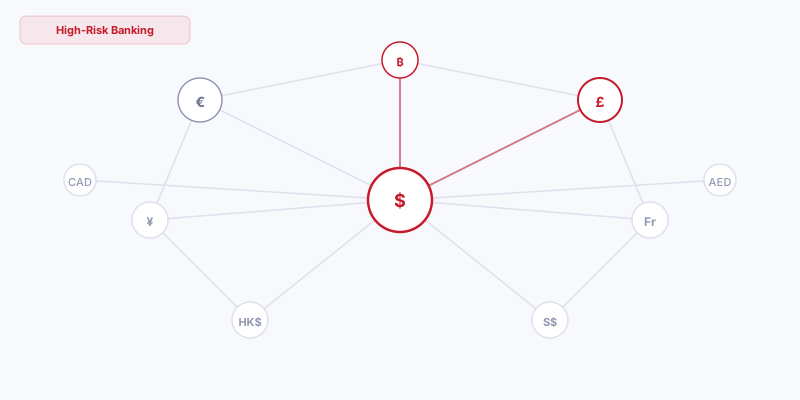
The central operational challenge for any crypto business is maintaining functional fiat banking alongside its digital asset operations. These two infrastructures pull in opposite directions: crypto operates 24/7, is borderless, and is pseudonymous; fiat banking operates on business day schedules, is jurisdiction-specific, and demands identity verification at every step. The businesses that navigate this successfully are the ones that understand precisely what banks need to see — and build their operations to demonstrate it.
Why Crypto Businesses Lose Fiat Banking
Most crypto businesses do not lose their bank accounts because of anything they have done wrong. They lose them because their bank's risk appetite changed, their transaction patterns triggered automated monitoring rules, or a compliance officer who understood the business moved on. The underlying cause is structural: traditional banking compliance frameworks were built for a world without blockchain, and most banks have not rebuilt them for one that includes it.
The specific triggers most commonly cited in account termination letters (where reasons are given at all) include: unexplained large inbound transfers, high transaction velocity, references to cryptocurrency in payment descriptions, counterparties identified as crypto exchanges on screening tools, and the general classification of the business as a money service business or cryptoasset business.
The Regulatory Framework for UK Crypto Businesses
Since January 2020, businesses carrying on cryptoasset exchange activities or custodian wallet services in the UK must register with the FCA under the Money Laundering, Terrorist Financing and Transfer of Funds (Information on the Payer) Regulations 2017 (MLR17) as amended by the Money Laundering and Terrorist Financing (Amendment) (EU Exit) Regulations 2020. FCA registration does not confer a banking relationship — it is a separate regulatory status — but it is an essential foundation for demonstrating legitimacy to payment institutions.
From September 2023, UK-registered cryptoasset businesses are subject to the UK Travel Rule, requiring them to collect and transmit originator and beneficiary information for cryptoasset transfers above £1,000. Compliance with the travel rule is increasingly used as a proxy measure by banks and payment firms assessing the quality of a crypto business's AML infrastructure.
Structuring the Fiat Banking Relationship
The most stable approach to fiat banking for a crypto business involves separating fiat operations into distinct functional accounts, each with a clear narrative that can be explained to a compliance officer:
Operational Account
The operational account receives subscription fees, trading commissions, or other fiat revenue from the business's primary activity. Inbound flows to this account should be exclusively from identified counterparties with a clear commercial relationship. This account should not receive bulk customer fiat deposits — mixing operational revenue with customer flows creates the monitoring anomalies that trigger bank reviews.
Customer Fiat Segregation Account
Where the business holds customer fiat pending conversion or withdrawal, this must be held in a clearly labelled segregation account, separate from operational funds and ideally at a different institution. This mirrors the safeguarding requirements for payment institutions and demonstrates to regulators and banking partners that customer funds are protected.
Settlement Account
The settlement account facilitates the conversion between fiat and crypto — receiving fiat from customers purchasing digital assets, or receiving fiat proceeds from customers selling digital assets. This is the account most likely to generate monitoring flags due to transaction volume and pattern. Using a specialist payment institution for this account, rather than a mainstream bank, reduces the risk of false positives leading to freezes.
Custody Infrastructure: Hot, Warm, and Cold
The custody side of a crypto business has its own structural requirements, and the decisions made here directly affect the fiat banking profile. Businesses that hold significant customer assets primarily in cold storage have a fundamentally different on-chain risk profile to those that hold substantial balances in hot wallets connected to liquidity providers.
Banks and payment institutions increasingly review the on-chain activity associated with a crypto business's known wallet addresses using tools like Chainalysis, Elliptic, or TRM Labs. If those wallets show interactions with sanctioned addresses, darknet market interactions, or high-risk counterparties, this will be flagged regardless of the volume or the business's stated compliance programme. Maintaining clean on-chain hygiene — including regular VASP-to-VASP transfers with properly transmitted travel rule data — is therefore directly relevant to fiat banking stability.
The AML Documentation Package
When onboarding a crypto business, a specialist payment institution will expect a comprehensive AML documentation package. This should include the registered business's FCA registration certificate, a copy of the firm's AML policy and procedures, evidence of travel rule compliance methodology, the firm's transaction monitoring system and alert handling procedures, a description of the customer onboarding process including KYC levels, and identification of the MLRO with their professional background.
Providing this documentation proactively, rather than in response to repeated queries, signals maturity and speeds the onboarding process significantly. Firms that cannot produce a coherent AML policy document — or whose MLRO cannot be identified — will face delays that are entirely self-inflicted.
Maintaining Multiple Fiat Relationships
Given the inherent fragility of fiat banking for crypto businesses, operating with a single payment relationship is unacceptable risk management. A minimum viable setup includes one primary payment institution for operational flows and customer-facing fiat, plus a secondary relationship that can be activated quickly if the primary relationship is disrupted. Switching costs are high and timelines are slow; the secondary relationship should be maintained actively, not held in reserve.
CCYFX onboards FCA-registered cryptoasset businesses and provides named IBAN accounts, multi-currency settlement, and on/off-ramp infrastructure calibrated to the specific compliance and operational requirements of digital asset businesses.
CCYFX provides specialist banking infrastructure for iGaming, crypto, FX brokers, and offshore structures. UK, European & US IBANs.
Speak to Our Team