Cryptocurrency payments in iGaming occupy a growing but compliance-intensive space. For MGA-licensed and other regulated operators serving international markets, crypto deposits offer genuine advantages: near-instant settlement, no chargeback risk, access to player segments with strong crypto adoption, and reduced dependence on the increasingly restrictive traditional card acquiring market. However, the compliance requirements for accepting crypto deposits — blockchain analytics, FCA registration, UK Travel Rule compliance, and source of funds obligations for large crypto deposits — are substantial. This guide addresses the practical framework for crypto payment integration in a licensed iGaming context.
The Regulatory Position for UKGC-Licensed Operators
For UKGC-licensed operators, accepting Bitcoin or other crypto deposits creates overlapping regulatory obligations. The Gambling Commission does not prohibit crypto deposits, but it requires that all payment methods comply with the operator's AML obligations under the LCCP. Crypto deposits that cannot be adequately screened for AML risk — for example, deposits from privacy coins such as Monero, where blockchain tracing is technically infeasible — cannot be accepted by a compliant UKGC operator.
Where the operator holds, converts, or exchanges crypto assets as part of accepting deposits, it may trigger registration requirements under the Money Laundering Regulations 2017 (MLR17) as a Cryptoasset Exchange Provider (CEP) or Cryptoasset Custodian Wallet Provider (CCWP). The FCA maintains the UK register of registered cryptoasset businesses. An iGaming operator that receives Bitcoin deposits into a wallet it controls and converts them to GBP is performing exchange and custodian activities that likely require MLR17 registration as a VASP (Virtual Asset Service Provider).
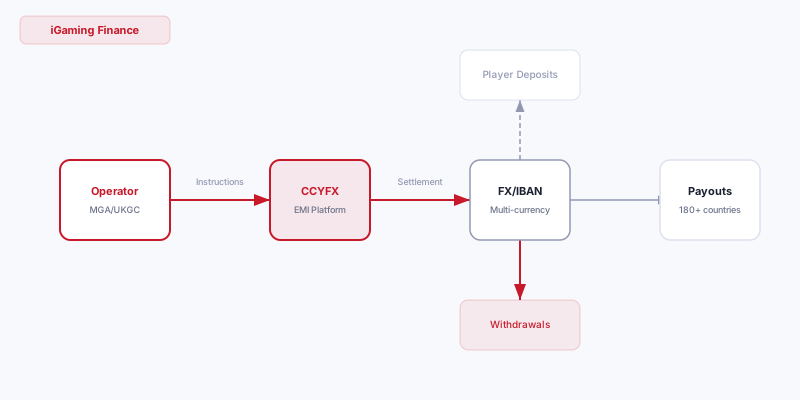
The practical solution for most licensed operators is to use an intermediary crypto payment processor — an FCA-registered VASP — that receives the crypto deposit from the player, performs the blockchain AML screening, and settles to the operator in fiat currency. This outsources the crypto-specific regulatory obligations to the payment processor while allowing the operator to offer crypto deposits under its existing UKGC licence.
Blockchain AML Screening
Every crypto deposit must be screened for AML risk before being accepted. The screening is performed using blockchain analytics tools — Chainalysis Reactor, Elliptic Lens, or TRM Labs — that trace the history of the incoming crypto and score it against known risk clusters. Key risk indicators that should result in automatic blocking or enhanced review include:
- Funds originating from or transiting through wallets associated with known ransomware operations
- Funds from wallets linked to darknet market activity
- Funds from wallets on OFAC's Specially Designated Nationals list or equivalent sanctions lists
- Funds passing through high-risk mixing or tumbling services designed to obscure transaction history
- High-risk exchange exposure — funds from exchanges in non-AML compliant jurisdictions
The screening must occur before the deposit is credited to the player's account, not retrospectively. An operator that credits a deposit and later discovers it originated from a sanctioned wallet has already received tainted funds — retrospective screening does not prevent this.
Stablecoins vs Volatile Crypto
Stablecoin deposits (USDT issued by Tether on Tron or Ethereum, USDC issued by Circle) are operationally preferable to Bitcoin or Ethereum deposits for most iGaming operators. The primary reasons are:
No conversion risk: A Bitcoin deposit received when BTC is at $60,000 may be worth $50,000 by the time the player wagers. If the player fund is valued in fiat terms, the operator has created an unsecured liability. With stablecoins, the fiat value is constant throughout the player's lifecycle, eliminating this risk entirely.
Lower volatility in source of funds assessment: Stablecoins are primarily held and transacted by players who specifically want a stable store of value for payments — a different profile from Bitcoin holders, who may have acquired BTC from a range of sources. USDC in particular benefits from Circle's regulated status in the US, which provides some additional provenance confidence, though the operator must still screen each incoming USDC transaction independently.
Faster settlement: USDT on Tron (TRC-20) and USDC on Solana settle in seconds at minimal cost. Bitcoin transactions require confirmation windows that can range from minutes to hours depending on network congestion and the fee attached to the transaction.
The UK Travel Rule and Crypto Deposits
The UK Travel Rule, which came into force in September 2023 under the amended Money Laundering Regulations 2017, requires that virtual asset service providers transmitting crypto above £1,000 include originator and beneficiary information with the transfer. For iGaming operators receiving crypto deposits via a registered VASP processor, the Travel Rule obligation rests with the VASP. However, operators must ensure their VASP processor is compliant and must not accept deposits where Travel Rule data is unavailable above the threshold.
For operators considering self-custody of crypto wallets to accept deposits directly, Travel Rule compliance is their direct responsibility — they must capture and transmit player information with any outbound crypto transfer above the threshold, and must verify incoming Travel Rule data before crediting deposits. This adds significant operational complexity to a direct crypto acceptance model.
CCYFX provides specialist banking infrastructure for iGaming, crypto, FX brokers, and offshore structures. UK, European & US IBANs.
Speak to Our Team