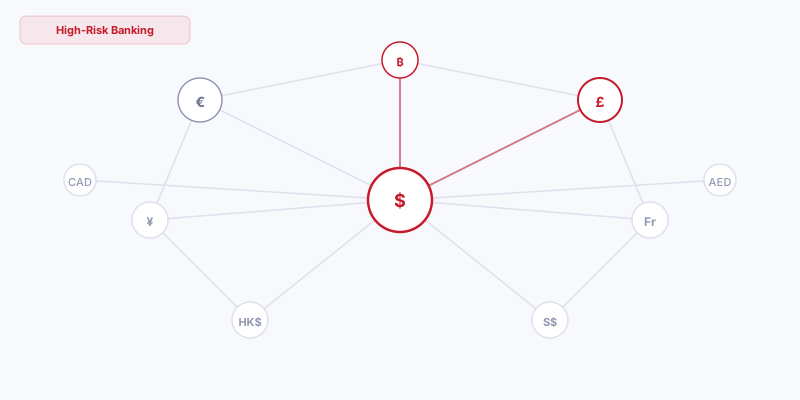
Banking access for iGaming operators is one of the most persistently challenging problems in the sector. Despite the existence of rigorous regulatory frameworks — the UK Gambling Commission, the Malta Gaming Authority, and increasingly robust licensing in other jurisdictions — the sector faces systematic de-risking from mainstream banks and payment processors. The consequence is that payment infrastructure management has become a core competency for iGaming operators: those who build resilient, diversified payment infrastructure can scale without payment disruption; those who rely on a single banking relationship or acquiring relationship are perpetually one account closure away from a business-critical crisis.
Why iGaming Banking Access Remains Difficult
The banking challenges facing iGaming operators are not primarily about compliance quality — well-licenced, AML-compliant operators face the same mainstream bank refusals as less rigorous operators. The challenge is sector-level risk management by banks. iGaming accounts generate: high transaction volumes with many small-value deposits and withdrawals; elevated chargeback rates relative to mainstream commercial accounts (players who request refunds via their bank rather than through the operator's customer service); customer geography spanning multiple jurisdictions including higher-risk markets; and regulatory complexity requiring ongoing compliance investment that most mainstream banks are not resourced to manage.
The reputational dimension adds further complexity. Despite the existence of respected regulators like UKGC and MGA, the gambling sector retains a negative social perception among the boards of large institutional banks. This reputational caution, combined with the genuine compliance complexity, produces blanket sector restrictions that affect all operators — regardless of licence quality or individual compliance standards.
The Core Infrastructure: Specialist EMIs
FCA-authorised specialist EMIs with an explicit risk appetite for iGaming are the backbone of most operators' banking infrastructure. These institutions understand the transaction flow characteristics of iGaming — high-volume small deposits, high-volume player withdrawals, seasonal volume spikes around major sporting events — and have compliance frameworks calibrated to assess and monitor iGaming clients appropriately. Named IBANs through specialist EMIs provide GBP and EUR accounts in the operator's own name, enabling counterparties (acquiring banks, affiliate payment processors, B2B suppliers) to make payments directly to the operator's account rather than through a pooled payment arrangement.
The operator's ideal EMI infrastructure involves multiple providers: a primary GBP account for UK operations, a primary EUR account for European operations (ideally through an EU-regulated EMI for SEPA access), and at least one backup account at a different provider for each currency. The backup account should be fully onboarded and active — not merely applied for — so that it can be operationalised within hours if the primary account is disrupted. Operators who maintain accounts that are technically open but have zero balances and no transaction history for extended periods frequently find that those accounts are closed as inactive, eliminating the backup just when it would be needed.
Player Funds Segregation Infrastructure
UKGC-licenced operators must maintain player funds accounts with specific protections dependent on their player fund protection level (basic, medium, or high). The player funds account — a segregated account holding at least 100% of aggregate player liability — must be held at an institution that has acknowledged the segregated nature of the funds and their unavailability to the operator for its own purposes. Securing a player funds account acknowledgment letter from the account-holding institution has become more difficult as mainstream banks have de-risked the sector. Specialist EMIs that serve iGaming clients can typically provide this documentation, and operators should confirm player funds account capability as part of the EMI onboarding process rather than assuming it is available.
Card Acquiring: The Parallel Challenge
Card acquiring — accepting Visa and Mastercard deposits from players — is a separate challenge from banking. Card scheme rules classify iGaming under specific MCCs (7801/7802/7995) with elevated monitoring requirements. Chargeback rates in iGaming are elevated relative to most retail sectors because players use the card dispute mechanism as a refund route, particularly for bonus-funded deposits and in markets where responsible gambling protections generate more disputes. Maintaining chargeback rates below card scheme thresholds (Visa's 1.0% chargeback-to-transaction ratio) is an ongoing operational requirement that requires dedicated chargeback management capability.
iGaming operators serving markets where Visa and Mastercard deposits face additional restrictions — many card issuers in the UK have implemented voluntary gambling blocking tools and some European markets restrict card gambling deposits — need alternative payment methods alongside card acquiring. Open banking deposit solutions (which route player deposits as bank transfers rather than card transactions, eliminating chargeback risk), e-wallets (PayPal, Skrill, Neteller where applicable), and crypto on/off ramp infrastructure all contribute to a payment mix that is resilient against disruption to any single payment method.
The Long-Term Strategy
The operators with the most stable payment infrastructure treat it as a strategic asset — actively managing provider relationships, maintaining genuine backup accounts, diversifying payment methods, and investing in compliance infrastructure that makes each banking relationship defensible. iGaming operators who invest in their AML framework, provide proactive compliance updates to payment providers, and engage with their banking partners as relationships rather than utilities consistently maintain more stable access than those who treat payment accounts as commodities. In a sector where banking access is genuinely scarce, the quality of the relationship management is a direct determinant of operational resilience.
CCYFX provides specialist banking infrastructure for complex businesses. UK, European & US IBANs, FX hedging, crypto on/off ramp, and global payouts to 180+ countries.
Speak to Our Team