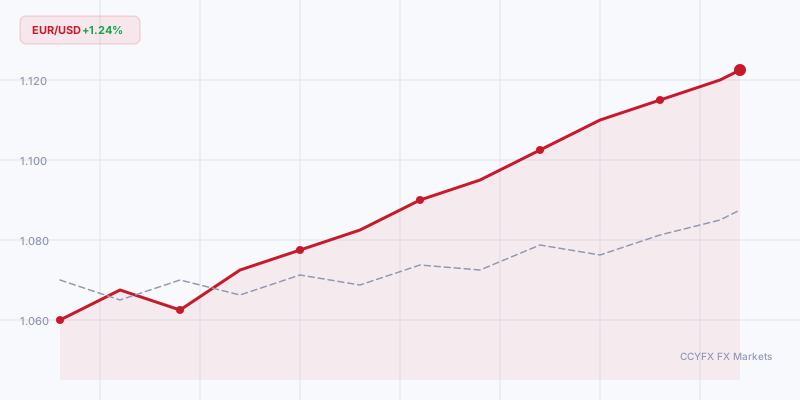
The moment at which earnings held in an offshore subsidiary are repatriated as dividends to a parent or ultimate holding company is one of the most significant FX crystallisation events in the corporate calendar. Unlike the continuous flow of transaction exposures (individual sales, purchases, payroll) that treasury teams manage daily, dividend repatriation typically occurs in discrete, large-value transfers — a quarterly EUR dividend from a Malta subsidiary, an annual HKD distribution from the Asia operations, a USD transfer from the Cayman holding company to founders. The FX rate at which each conversion happens has a material impact on the quantum of value actually received. Yet many privately held offshore structures leave this entirely to chance — converting at whatever spot rate happens to prevail on the day the dividend is declared and paid.
The FX Decision in Dividend Repatriation
A dividend repatriation from an offshore subsidiary to an ultimate investor or parent holding company involves at minimum one currency conversion: from the subsidiary's functional currency to the recipient's functional currency. For a Maltese EUR-functional operating company paying a dividend to a Cayman USD-functional holding company, the conversion is EUR to USD. If EUR/USD is 1.12 rather than 1.05 at the time of conversion, the USD value of a €1 million dividend increases by approximately $70,000 — a 6.7% value difference attributable entirely to the timing of the conversion decision.
Three factors make this FX exposure more tractable than it might appear. First, dividend repatriation is usually discretionary in timing — unlike trade payables which must be settled on commercial terms, dividends from wholly or majority-owned subsidiaries can generally be declared and paid at the holding company's chosen time, within the constraints of the subsidiary's solvency and distributable reserves. This timing discretion is a real option with economic value that should be managed actively rather than ignored. Second, the FX amount is typically known in advance (based on available distributable reserves), allowing forward hedging. Third, the exposure is large enough to warrant institutional FX rates — a €500,000 dividend conversion executed at 0.15% rather than 1.5% saves €6,750 relative to a typical bank retail rate.
Capital Controls and Repatriation Restrictions
Not all dividend repatriation flows are freely executable. Capital controls and exchange regulations in certain jurisdictions impose procedural requirements or substantive limits on cross-border dividend transfers that affect both the mechanics of repatriation and the FX conversion options available.
China is the most significant example. Dividends from WFOE (Wholly Foreign-Owned Enterprise) subsidiaries in mainland China require regulatory approval from the State Administration of Foreign Exchange (SAFE) before CNY can be converted to USD or other foreign currencies for repatriation. The approval process requires audit completion for the relevant year, tax clearance, and submission to the local SAFE office. Processing times vary from 2–8 weeks. The approved conversion uses the PBOC CNY/USD fixing rate at the time of conversion — there is no market-rate alternative for onshore CNY conversion. Offshore CNH accumulated in Hong Kong can be managed more flexibly.
India presents similar constraints. Dividends from Indian subsidiaries to foreign parent companies are technically freely repatriable under the Foreign Exchange Management Act 1999 (FEMA), but the practical process involves withholding tax deduction (typically 10–20% depending on the applicable double taxation treaty), RBI reporting, and bank compliance scrutiny that can add several weeks to the process. The INR is not freely convertible; the conversion from INR to USD at the time of payment uses the prevailing interbank rate through the authorised dealer banking system.
For jurisdictions without capital controls — Malta, Gibraltar, BVI, Cayman, UK, Singapore — repatriation is operationally straightforward once the dividend has been declared by the subsidiary board and the transfer instruction issued. These jurisdictions represent the majority of offshore structures in CCYFX's client base.
Withholding Tax and the FX Interaction
Withholding tax on cross-border dividends interacts with FX in a way that is occasionally misunderstood in treasury planning. Withholding tax is typically deducted from the gross dividend in the source jurisdiction before the net amount is converted and remitted. This means the FX conversion applies to the post-withholding net amount — not the gross dividend declared. The withholding tax itself is settled with the source country's tax authority in local currency, at the rate prevailing when the tax is paid.
This creates a secondary FX consideration: the timing of withholding tax payment affects the FX rate at which that component of the dividend is effectively converted. If a company is managing the FX rate on the net dividend through forward hedging, the withholding tax component (paid separately to the local tax authority at spot) remains unhedged and creates a small residual exposure. For large dividend flows with material withholding tax, this should be reflected in the hedge sizing.
Forward Hedging of Known Dividend Flows
Where a dividend declaration date and approximate quantum is known in advance — as it frequently is for companies with predictable annual distributions — forward hedging is the most reliable tool for rate management. The process is: (a) determine the expected dividend declaration date and net currency amount post withholding; (b) execute a forward to sell the source currency and buy the destination currency for value on or shortly after the expected settlement date; (c) if the actual dividend declaration results in a different amount than forecast, adjust the forward through a partial unwind or extension.
For EUR/USD dividend conversions, 1–6 month forward rates are well-supported with tight bid-offer spreads. The cost of a forward is the interest rate differential between the two currencies — in EUR/USD, where EUR rates (ECB deposit rate ~2.5%) are below USD rates (Fed funds ~4.25%), the EUR forward is at a discount to spot for a EUR seller/USD buyer — meaning a company selling EUR forward to buy USD will receive a slightly lower rate than current spot. This is the cost of rate certainty, and it is typically modest relative to the rate variance from leaving conversion timing to chance.
CCYFX supports dividend repatriation FX for offshore corporate structures with forward execution, multi-currency account infrastructure across the relevant jurisdictions, and the relationship management to coordinate the full payment and conversion process. Contact us at info@ccyfx.com to discuss your annual repatriation programme.
CCYFX provides FX and payment infrastructure for offshore dividend repatriation across BVI, Cayman, Malta, Gibraltar, HK and Singapore structures.
Discuss Your Repatriation Programme