The range of payment methods available to iGaming players has expanded significantly over the past decade, while regulatory changes have narrowed certain options. In 2026, an operator offering a competitive player experience must support a diverse payment method stack, with each method carrying its own commercial, compliance, and operational characteristics. This guide provides a comprehensive assessment of each major method.
Debit Cards: The UK's Dominant Method
Following the UKGC's prohibition on credit card gambling deposits (effective April 2020), debit card is the primary card payment method for UK players. Visa Debit and Mastercard Debit account for the majority of card deposits at UK-licensed operators.
Commercial characteristics: Interchange rates for gambling merchant category (MCC 7995) have historically been higher than for standard retail, reflecting the elevated chargeback risk. Acquirers typically charge 1.5–3% of gross gaming revenue on card deposits, with the exact rate depending on volume and the operator's chargeback history. Debit card deposits settle to the acquirer's merchant account typically one to three business days after transaction date.
Chargeback risk: Chargeback rates for online gambling are higher than most retail sectors — typically 0.5–2% of transactions. Chargebacks arise from card-not-present fraud (stolen card details), friendly fraud (player disputes a legitimate transaction), and disputes where the player did not recognise the merchant descriptor on their statement. Strong Customer Authentication (SCA) under PSD2/UK Payment Services Regulations 2017 has reduced fraud-related chargebacks but not eliminated friendly fraud.
Withdrawal method: Winnings above the original deposit amount cannot be returned via card. The Visa and Mastercard Original Credit Transaction (OCT) facility returns funds to the depositing card — essential for compliance with UKGC third-party payment rules — but is limited to amounts up to the original deposit. Excess winnings must be paid by bank transfer or e-wallet.
Open Banking: The Rising Challenger
Account-to-account (A2A) payments via open banking — using Payment Initiation Service Providers (PISPs) under the Payment Services Regulations 2017 implementing PSD2 — have become an increasingly significant deposit method. Providers including Trustly (via Pay N Play), Volt, Token, and TrueLayer offer instant bank transfer deposits with biometric authentication through the player's mobile banking app.
Key advantages: No chargeback risk — bank transfers are irrevocable once processed. Settlement is near-instant via Faster Payments. The player's identity is confirmed via their bank's authentication, providing a high-confidence KYC signal. Transaction costs are typically lower than card acquiring.
Regulatory consideration: Open banking deposits from verified bank accounts provide strong data for responsible gambling monitoring. Some operators and gambling harm specialists have noted that the frictionless nature of open banking — removing the physical act of entering card details, which provides a moment of pause — may reduce behavioural friction for at-risk gamblers. The UKGC has not mandated specific friction requirements for open banking but expects operators to consider this in their responsible gambling frameworks.
E-Wallets: PayPal, Skrill, and Neteller
E-wallet payments via PayPal, Skrill (Paysafe), and Neteller remain significant in the UK and European markets. Players pre-fund an e-wallet account and deposit to the casino from the wallet balance; withdrawals are returned to the wallet.
E-wallet deposits provide a layer of separation between the casino and the player's bank account, which some players prefer for privacy. However, where a player deposits from an e-wallet funded by a credit card, the UKGC's credit card gambling ban may be triggered — operators must ensure e-wallet providers have controls in place to prevent credit card-funded deposits reaching gambling sites.
Crypto Payments in iGaming
Crypto payment options — Bitcoin, Ethereum, USDT, and other tokens — are available at some MGA-licensed and offshore-licensed operators. For UKGC-licensed operators, accepting crypto deposits creates significant compliance complexity: the operator must comply with FCA crypto AML regulations if it is holding or converting digital assets, and must ensure adequate source-of-funds verification on large crypto deposits.
Stablecoin deposits (USDT, USDC) are the most operationally straightforward crypto option, as their fiat-pegged value eliminates the conversion risk that Bitcoin or Ethereum deposits create if price moves between deposit time and wagering time.
Prepaid Vouchers
Paysafecard and similar prepaid voucher products allow players to pay by a voucher code loaded with a fixed cash value, purchased at retail locations or online. This method is particularly used by younger players or those without bank accounts. Withdrawal is not possible via prepaid voucher — winnings must be paid by an alternative method — making reconciliation straightforward but limiting the method's utility for high-value players.
From an AML perspective, prepaid vouchers present a risk as they can be purchased anonymously at cash machines. Operators should apply enhanced due diligence to players whose deposits are predominantly or exclusively via prepaid voucher, particularly where the volume is high.
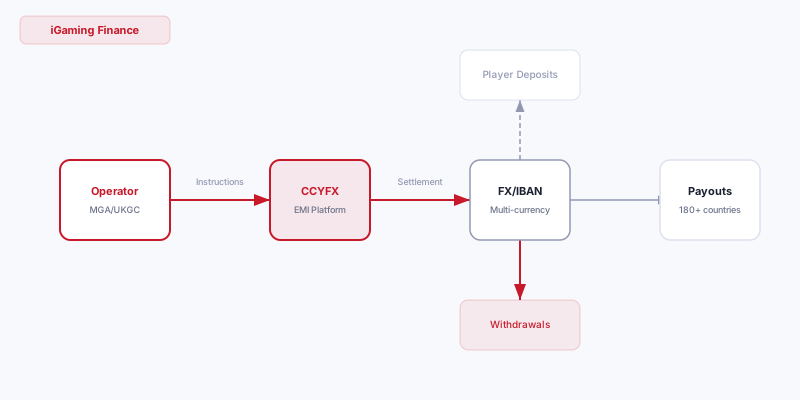
CCYFX provides specialist banking infrastructure for iGaming, crypto, FX brokers, and offshore structures. UK, European & US IBANs.
Speak to Our Team