Sports betting presents distinct payment infrastructure challenges that differ meaningfully from casino operations. The event-driven nature of sports betting — with massive spikes in deposit and withdrawal volumes around major sporting events — requires infrastructure that can scale dramatically and at short notice. The specific compliance requirements of UKGC-licensed sportsbooks add further complexity. This guide addresses the infrastructure requirements in detail.
The Sports Betting Payment Flow
The payment lifecycle in sports betting has a characteristic pattern that any competent payment infrastructure must accommodate. Deposits spike in the hours before popular fixtures — particularly football, horse racing, and major events like the Grand National, the Cheltenham Festival, or international football tournaments. Following the event, withdrawal requests surge as winning bettors seek to access their funds.
The timing asymmetry is critical: deposits and withdrawals do not balance in real time. A significant football event might generate ten times the normal deposit volume in the two hours before kick-off, followed by a high withdrawal volume in the 30 minutes after the final whistle. The payment infrastructure — and the float management behind it — must accommodate this pattern without delays.
Deposit Method Requirements for Sportsbooks
For UKGC-licensed operators, deposit method choices are constrained by the UKGC's prohibition on credit card gambling (effective April 2020 under revised LCCP Condition 6). Accepted deposit methods are debit card, bank transfer via Faster Payments or Open Banking, e-wallets (PayPal, Skrill, Neteller), and prepaid voucher products (Paysafecard).
Debit card deposits via Visa and Mastercard remain the most popular method for UK bettors. Acquirer relationships for debit card acquiring in the sports betting MCC (Merchant Category Code 7995) require the acquirer to have explicit appetite for licensed gambling merchants. The chargeback rate for sports betting is typically lower than for casino gaming — bettors are less inclined to dispute a bet that was placed intentionally, even if the outcome was unfavourable — which helps maintain acquirer relationships.
Open Banking deposits via Account Information Service Providers (AISPs) and Payment Initiation Service Providers (PISPs) have grown significantly since 2022. Instant account-to-account transfers eliminate card network fees, reduce chargeback risk (bank transfers are irrevocable once processed), and provide immediate confirmation of funds. For operators, open banking deposits are preferable on cost; for players, the friction of bank authentication has reduced as mobile banking apps have improved biometric confirmation flows.
Managing Peak Volume Events
The key operational challenge for sportsbook treasury is pre-positioning float for major events. A sportsbook offering enhanced odds on a Champions League final or a major horse racing event should model expected inbound deposits and outbound payout volumes based on historical event data, then ensure sufficient pre-funding is in place before the event window opens.
The practical approach is to maintain a rolling float in the withdrawal account calibrated to 150–200% of the expected peak daily withdrawal volume for normal periods, increasing this buffer to 300–400% in the week leading up to major annual events such as the Cheltenham Festival or World Cup fixtures.
Coordination between the trading team — who know what liability positions are building — and the treasury team is essential. A sportsbook that has taken a large liability on a particular outcome may face a wave of near-simultaneous withdrawal requests if that outcome occurs. Pre-positioning the withdrawal float before the liability materialises, rather than trying to top up the float after the result, is the operationally resilient approach.
UKGC Compliance Requirements Affecting Payment Processing
The UKGC's LCCP imposes specific requirements that affect payment infrastructure directly:
Third-party payment prohibition (LCCP 6.1.2): withdrawals must be returned to the same payment method as the deposit where technically feasible. A player who deposited by debit card must receive their withdrawal to the same card (via Original Credit Transaction) rather than to an unconnected bank account. This requires OCT capability from the operator's acquiring partner.
Self-exclusion integration: the payment infrastructure must check player self-exclusion status before processing any deposit. A self-excluded player attempting a deposit must be blocked at the payment initiation stage, not just at the account level — this requires real-time integration between the payment processing system and the self-exclusion registry, whether GAMSTOP for UK players or equivalent systems in other jurisdictions.
Withdrawal processing speed: the UKGC expects withdrawals to be processed without undue delay. Industry practice has moved to same-day withdrawals as standard; operators that delay withdrawals without valid compliance grounds risk LCCP compliance reviews.
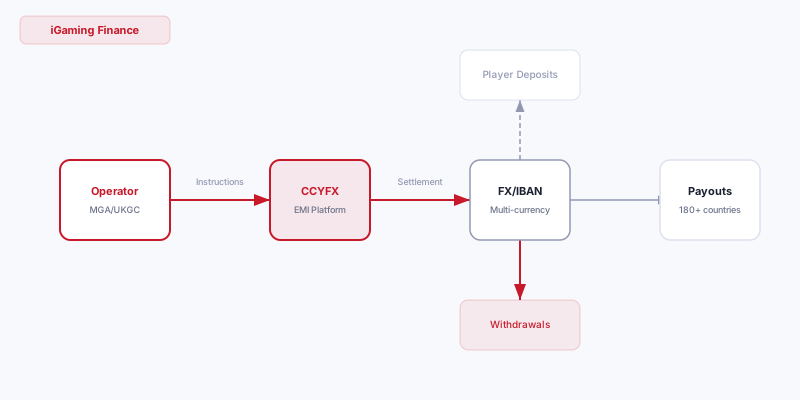
CCYFX serves sportsbook operators with named IBAN accounts, Faster Payments direct access, and multi-currency FX conversion, with infrastructure designed to accommodate peak event volumes without manual intervention.
CCYFX provides specialist banking infrastructure for iGaming, crypto, FX brokers, and offshore structures. UK, European & US IBANs.
Speak to Our Team