%20(1520%20x%20400%20px).avif)
Swiss Franc vs. U.S. Dollar: Why the Smart Money Is Shifting Toward the Franc
The Swiss Franc’s Quiet Dominance
While the global macro conversation remains fixated on the strength of the U.S. dollar, the Swiss franc (CHF) has quietly outperformed most major currencies in 2025 — cementing its role as one of the few true “hard currencies” left in a world of policy-driven volatility.
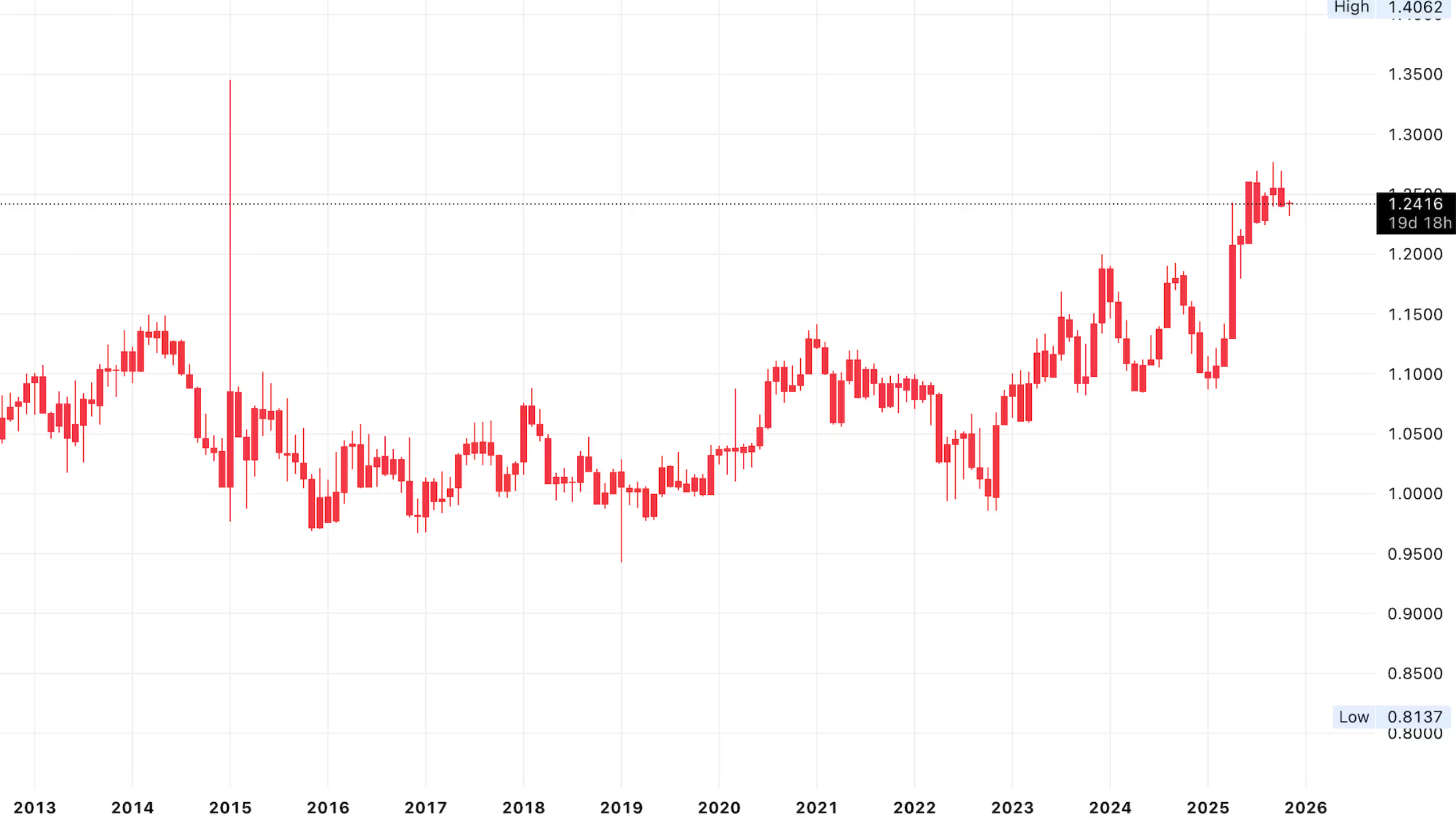
The CHF/USD pair, now trading around 1.24, has appreciated nearly 15% since late 2023, outperforming both the euro and the pound. Behind this move lies a familiar mix of monetary conservatism, trade surpluses, and safe-haven capital inflows that continue to define Switzerland’s macro profile.
1. Monetary Prudence in a World of Liquidity
While the Federal Reserve has oscillated between hawkish posturing and liquidity injections to stabilize debt markets, the Swiss National Bank (SNB) has remained anchored in its historic prudence.
Even after modest rate cuts earlier in 2025, Switzerland’s real interest rates remain positive, unlike the U.S., where persistent fiscal expansion and rising Treasury yields have flattened inflation-adjusted returns.
SNB policy prioritizes currency stability over stimulus, allowing the franc to strengthen naturally through capital inflows rather than intervention. This has re-established the franc as a store of value, not just a medium of exchange — a key differentiator in today’s global currency landscape.
2. Switzerland’s Balance Sheet vs. America’s Deficit Spiral
Switzerland continues to post one of the world’s most robust current account surpluses, consistently above 10% of GDP. Meanwhile, the U.S. faces record twin deficits — fiscal and current — with debt-to-GDP nearing 130% and rising.
Global investors are increasingly wary of holding assets denominated in a currency backed by structural deficits and political gridlock. The franc, by contrast, is underpinned by national savings, low debt, and a disciplined central bank balance sheet.
As one Geneva-based FX strategist put it:
“The U.S. dollar is the world’s transaction currency. The Swiss franc is the world’s preservation currency.”
3. The Dollar’s Diminishing Safe-Haven Status
Traditionally, market stress drove capital into the dollar. That relationship has weakened. The U.S. debt ceiling standoff in 2024, combined with rising geopolitical exposure in Asia and the Middle East, has diluted the USD’s reputation as the ultimate refuge.
Meanwhile, the franc has benefited from geopolitical neutrality, a stable banking system, and limited sovereign risk. Swiss private banks and EMIs report a noticeable uptick in institutional demand for CHF accounts, especially from Asia, Eastern Europe, and the Middle East.
In periods of market uncertainty, Swiss assets attract sticky capital — investors seeking safety rather than yield. This structural demand underpins long-term CHF strength, even during risk-on cycles.
4. Technical Outlook: 1.24 Could Be the Floor, Not the Ceiling
The long-term CHF/USD monthly chart shows a decisive breakout above the 1.20 consolidation range — a resistance level that held firm for nearly a decade.
This breakout signals structural revaluation, not speculative volatility. The next resistance level sits near 1.30, with potential extension toward 1.35–1.40 if U.S. inflation remains stubborn or if another liquidity cycle begins in 2026.
Conversely, downside support remains at 1.18–1.20, which aligns with prior breakout levels — suggesting that short-term pullbacks will likely be met with renewed buying interest.
5. Why Institutional Portfolios Are Tilting Toward CHF
- Inflation Hedge: CHF-denominated assets historically hold purchasing power better than USD or EUR during inflationary cycles.
- Banking Stability: Swiss institutions remain well-capitalized and conservative in leverage, offering systemic resilience.
- Regulatory Trust: FINMA’s global reputation for integrity reinforces investor confidence, particularly in cross-border transactions.
- FX Diversification: For multinational corporations, holding CHF reserves offers natural hedging against dollar depreciation.
As multi-asset funds rebalance for 2026, we are observing a gradual portfolio shift toward CHF reserves and Swiss short-term paper, echoing similar flows last seen during the 2011–2015 euro crisis period.
Conclusion: The Franc’s Quiet Renaissance
The Swiss franc’s rise isn’t speculative — it’s structural. Driven by fiscal discipline, central bank credibility, and geopolitical neutrality, the CHF offers a store of value in a global economy saturated with liquidity and uncertainty.
The USD may remain the world’s transactional king, but the franc is becoming its monetary conscience — a reminder that in the long run, trust and restraint outperform volume and volatility.
Key Takeaway for Investors
In 2025, holding francs isn’t just a currency play — it’s a vote of confidence in prudence.
For investors managing treasury risk or seeking diversification away from dollar exposure, the CHF continues to represent a defensive yet appreciating asset, backed by one of the soundest economies on earth.
Our latest articles.
Lorem ipsum dolor sit amet, consectetur adipiscing elit, sed do eiusmod tempor incididunt ut labore et dolores.