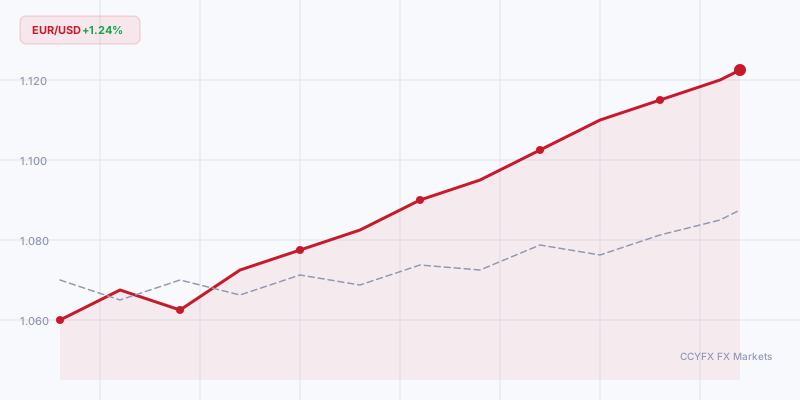
The August 2024 carry trade unwind — in which USD/JPY fell 12% in three weeks as the Bank of Japan raised rates and speculative JPY shorts were forced to cover — was a dress rehearsal for what happens when the global FX carry trade reverses sharply. In 2026, with the BoJ continuing its normalisation path toward 1.0% policy rates and the Fed in hold mode, the structural conditions for another carry unwind are materially present. Corporate FX desks that have not stress-tested their currency positions against a sudden 8–12% move in JPY, MXN, or TRY are taking on risk they may not have measured.
This analysis examines the mechanics of carry trade dynamics, the currencies most at risk in 2026, and the practical implications for corporate treasury teams — particularly those in high-risk industries where banking relationships and payment infrastructure may limit hedging options.
Carry Trade Mechanics: A Brief Primer
The FX carry trade involves borrowing in a low-interest-rate currency (the "funding currency") and investing in a higher-yielding currency (the "target currency"). The profit is the interest rate differential, and the strategy works as long as the exchange rate between the two currencies is stable or moves in the carry trader's favour. The risk is that a sharp reversal — typically triggered by risk-off sentiment, a policy surprise, or a margin call cascade — causes the target currency to fall sharply as carry traders close positions simultaneously.
The classic funding currencies are JPY (Bank of Japan policy rate currently 0.75%), CHF (SNB rate 0.75%), and until recently EUR. The target currencies — those offering significant yield premium — have been MXN (~9.5%), BRL (~10.25%), TRY (40%+, though distorted by inflation dynamics), ZAR (~7.25%), and HUF (~6.5%). USD at 4.25–4.50% has also served as a target currency versus JPY in the recent cycle.
The JPY Risk
The Bank of Japan's policy normalisation is the most significant carry trade risk in 2026. The BoJ raised its policy rate to 0.75% in January 2026 and has signalled a further 25bp increase is possible in H1 2026 if wage inflation — which reached a 32-year high in 2025 spring wage negotiations — remains elevated. Each BoJ hike narrows the JPY funding advantage and puts pressure on the estimated $400–600 billion in outstanding carry positions funded in JPY.
The August 2024 episode demonstrated the non-linear nature of carry unwinds: the initial BoJ rate surprise was modest (25bp to 0.25%), but the subsequent positioning unwind was outsized. In 2026, if the BoJ signals or delivers a move to 1.0%, a similar non-linear response is plausible. USD/JPY could correct from current levels near 148 to 132–135 — a 9–10% move — within weeks.
Implications for Corporate FX Desks
Businesses With JPY Revenues
Companies with Japanese revenues — whether iGaming operators with Japanese player bases, technology firms selling to Japanese customers, or manufacturers with Japanese distributors — are structurally long JPY. A JPY appreciation event is actually positive for these businesses in USD or EUR terms, and their forward hedge book should reflect this: aggressive USD/JPY forward selling by these businesses would lock in current rates and miss the potential windfall from JPY strength. An options strategy (JPY calls / USD puts) allows upside participation if JPY strengthens while providing a floor if the carry trade persists.
Businesses With JPY Costs
The reverse applies for businesses with JPY cost exposure — technology companies licensing Japanese IP, firms with Japanese supplier chains, or those servicing JPY-denominated debt. These businesses should have material forward cover for JPY purchases at current rates, as the downside from a JPY appreciation event without hedges is significant. At USD/JPY 148, buying JPY forward for 6 months costs approximately 1.2% in forward points (reflecting the US/Japan rate differential) — modest insurance against a potential 9–12% adverse move.
Businesses With EM Currency Exposure
A JPY carry unwind typically triggers broad EM selling as risk appetite collapses simultaneously. Businesses with exposure to MXN, BRL, ZAR, or TRY should scenario-plan for these currencies to weaken 10–20% in a carry reversal event. For iGaming operators with LatAm player bases, for example, a BRL depreciation event reduces the USD value of BRL player balances and makes BRL withdrawals more expensive in USD terms. Pre-funded BRL balances should be sized to cover at least two months of projected BRL withdrawal demand, insulating operations from acute liquidity stress in a volatile episode.
The CVIX Metric and Hedging Cost
The Deutsche Bank Currency Volatility Index (CVIX) — a broad measure of implied volatility across G7 FX pairs — currently sits around 8.5, elevated relative to the 6–7 range that characterised 2021–2022. Elevated CVIX means options premiums are higher: a 3-month EUR/USD 25-delta risk reversal costs approximately 0.9% today versus 0.6% in a low-volatility environment. This makes pure options-based hedging strategies more expensive, which is why layered strategies combining forwards and options are generally preferred when volatility is elevated.
Policy-Driven Currency Events Are Now More Frequent
The broader lesson of 2025–2026 for corporate FX managers is that policy divergence — central banks in different economies at materially different points in their rate cycles — creates a structurally more volatile FX environment than the 2010–2020 decade of synchronised low rates. The tools for managing this are well-established: documented hedging policies, regular exposure mapping, layered forward and options programs. The discipline to execute them consistently, regardless of market direction, is what separates businesses that treat FX as a managed cost from those that discover their currency exposure in a quarterly P&L surprise.
CCYFX provides specialist banking infrastructure for complex businesses including iGaming operators, crypto exchanges, FX brokers, and offshore structures. UK, European & US IBANs. T+0 settlement.
Speak to Our Team