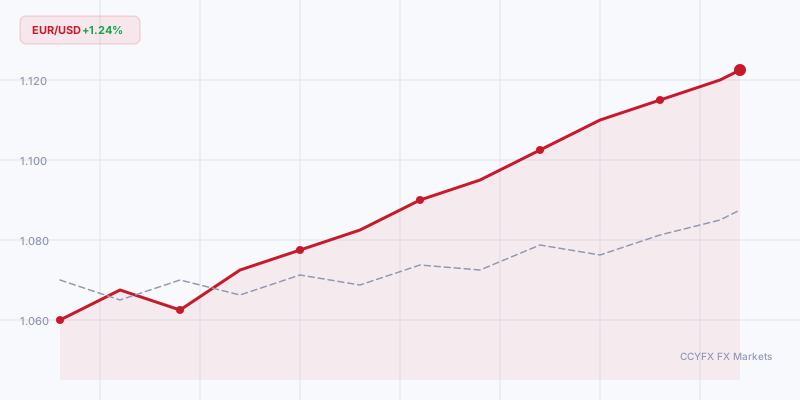
The EUR/USD pair enters Q2 2026 at an inflection point. After eighteen months of sustained dollar strength driven by the Federal Reserve's restrictive policy stance, the macro backdrop is shifting. Markets are pricing a prolonged Fed hold rather than further hikes, ECB rate cuts have reached their probable floor, and European fiscal dynamics — particularly German defence spending commitments following NATO renegotiations — are injecting an unexpected bid into the single currency.
For corporate treasury teams managing EUR/USD exposure, the key question is no longer whether dollar strength continues but whether the conditions for a structural reversal are now in place. This analysis examines the factors driving the pair and offers practical guidance for finance directors managing cross-currency payment flows.
Fed Policy: From Restrictive to Neutral
The Federal Reserve's dot plot released in March 2026 confirmed what fed funds futures had been pricing for several weeks: the FOMC sees no further rate moves in either direction until at least Q3. With the Fed Funds target range at 4.25–4.50% and core PCE stubbornly above the 2% target at 2.7%, the case for cuts is not yet compelling — but neither is the case for further hikes given labour market softening.
The implication for USD is that the interest rate differential that drove dollar strength throughout 2024–2025 is no longer widening. The ECB's deposit rate, currently at 2.25% following three 25bp cuts since October 2025, is widely expected to bottom here. If ECB rate cuts pause while the Fed holds, the EUR/USD rate differential narrows by default — a mechanical tailwind for the euro.
European Fiscal Impulse: The German Factor
Perhaps the most significant structural shift for EUR/USD in 2026 is Germany's fiscal pivot. The constitutional debt brake reform passed in February 2026 unlocks an estimated €400 billion in defence and infrastructure spending over a decade. This is not peripheral eurozone spending — it is the German government issuing Bunds at scale for the first time in a generation.
German Bund supply at this level has two euro-positive effects: it narrows the yield gap with US Treasuries as German yields rise to absorb the issuance, and it signals a structural shift in European growth expectations. Goldman Sachs revised their EUR/USD year-end target upward to 1.14 following the Bundestag vote. While we would not rely on any single bank forecast, the direction of revision across the sell-side is consistent.
What This Means for Corporate Hedgers
Corporates with significant EUR receivables should be reviewing their forward book. The standard advice — hedge 50–75% of projected exposure rolling six months forward — remains sound, but the tenor and strike decisions matter more in a turning-rate environment than in a trend market.
Specific considerations for Q2 2026:
- EUR receivables businesses (e.g., European iGaming operators collecting in EUR, paying in GBP or USD): the current rate around 1.09–1.10 may represent a reasonable hedging floor if EUR/USD recovers toward 1.13–1.15 consensus targets. Locking in forward sales of EUR at current levels may leave value on the table.
- USD receivables businesses paying EUR costs: the reverse applies. Forwards at current levels lock in relatively favourable USD buying. Consider layering in forward purchases over Q2 and Q3 rather than waiting.
- Options: with 3-month EUR/USD implied volatility around 6.5%, vanilla call options on EUR are reasonably priced for businesses wanting upside participation without full forward commitment. A 1-month 1.12 EUR call costs approximately 0.4% of notional — modest insurance against a sharp EUR rally.
Payment Infrastructure Implications
For businesses running multi-currency payment operations — iGaming platforms, crypto exchanges, international payroll processors — EUR/USD volatility has direct P&L implications beyond hedging. The gap between the mid-rate and the rate your bank or PSP applies to your conversions is typically 1–2% at retail and 0.15–0.50% at institutional levels. On a €10 million monthly conversion volume, that spread difference is €85,000–185,000 per month.
At CCYFX, we see many businesses absorbing bank FX margins of 1.5–2% on EUR/USD conversions simply because the conversion is embedded in a payment instruction and never scrutinised. Finance teams often focus on their hedging program while leaving execution costs unexamined. In a market where EUR/USD may move 3–5% across a quarter, execution quality on live conversions matters as much as the hedge itself.
Key Risks to the EUR Bull Case
The euro-positive scenario is not without risk. Three scenarios could sustain or renew dollar strength in Q2:
- US inflation re-acceleration: a rebound in core CPI above 3.5% would reopen the door to Fed hikes, immediately restoring rate differential support for USD.
- European political risk: French or Italian political instability, or a breakdown in the NATO spending consensus, could quickly reverse the fiscal impulse narrative.
- China slowdown: EUR is more sensitive to China growth than USD due to the eurozone's export dependency. A meaningful deterioration in Chinese PMI data would weigh disproportionately on EUR.
For most corporate treasury programs, these risks reinforce a layered hedging approach rather than a binary position. Entering the quarter fully unhedged on EUR/USD exposure is as imprudent as being fully locked into forwards at current rates. A phased hedge — 40% forward, 20% vanilla options, 40% open — captures directional upside while limiting downside.
Practical Summary for Finance Directors
- EUR/USD directional bias for Q2 2026: modestly EUR-positive, driven by narrowing rate differentials and German fiscal expansion.
- Target range: 1.09 support / 1.14 resistance. Break above 1.14 opens 1.17–1.18 in H2.
- Review your forward book coverage ratio — if you are over 80% hedged with short-dated forwards, consider rolling some exposure into options to retain upside.
- Audit your payment execution rates — the cost of conversion on live payment flows is frequently larger than the P&L impact of your formal hedge program.
CCYFX provides specialist banking infrastructure for complex businesses including iGaming operators, crypto exchanges, FX brokers, and offshore structures. UK, European & US IBANs. T+0 settlement.
Speak to Our Team