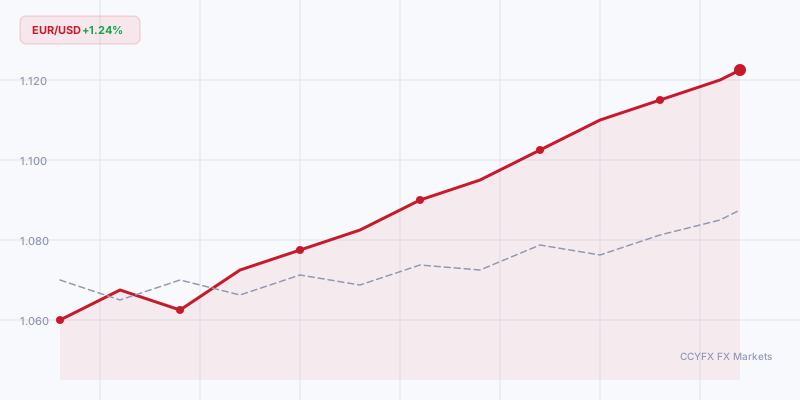
The UK's Autumn Budget 2025 marked a significant turning point for sterling's trajectory. The Chancellor's decision to raise employer National Insurance contributions and freeze income tax thresholds generated a sharp debate about the balance between fiscal consolidation and growth — and markets reacted accordingly. GBP/USD fell from 1.31 to below 1.27 in the two weeks following the Budget statement, before recovering partially to around 1.29 by year-end.
As we enter Q2 2026, sterling finds itself at the intersection of four competing forces: residual fiscal credibility concerns, Bank of England (BoE) rate cut expectations, US dollar softening, and the slowly improving UK trade relationship with the EU post-Brexit Trade and Cooperation Agreement review. For businesses with material GBP exposure — whether receivables, cost bases, or intercompany flows — understanding these dynamics is not optional.
Fiscal Credibility and the Gilt Market
The Budget's £40 billion tax increase — the largest since 1993 — was intended to restore fiscal headroom after the OBR revised down growth forecasts. The immediate market reaction drew uncomfortable comparisons to September 2022's mini-Budget, though the mechanism was different: this was a contractionary budget, not an expansionary one. The concern was not that the UK was spending recklessly, but that tax increases on employers would dampen investment, depress wage growth, and compress the BoE's room to cut.
Gilt yields have since stabilised, with 10-year gilts trading around 4.45% in Q1 2026. The spread versus German Bunds remains elevated at approximately 170 basis points — a structural premium the market demands for UK assets post-Brexit. This yield spread provides some technical support for sterling, as international investors continue to hold gilts for yield pick-up.
Bank of England Trajectory
The BoE has cut Bank Rate twice since the Budget, bringing it to 4.25% as of February 2026. The MPC's February minutes were notably cautious, with three members voting to hold on concerns about services inflation remaining above 5%. The market consensus for additional cuts in 2026 has narrowed to one or two 25bp reductions — a shallower path than was priced in late 2025.
For GBP/USD, the relative rate trajectory matters more than the absolute level. If the Fed holds at 4.25–4.50% and the BoE cuts to 3.75% by year-end, the rate differential closes from roughly flat to 50–75bp in USD's favour. This creates a modest headwind for sterling — not catastrophic, but meaningful for large cross-currency positions.
Practical Implications by Business Type
iGaming Operators Licensed in the UK
UK Gambling Commission licensees collecting GBP revenues while paying suppliers in EUR or USD face meaningful FX exposure. With GBP/USD in the 1.26–1.30 range, a reversion toward 1.24 (which several models suggest as fair value given purchasing power parity) would cost a business generating £5 million per month in GBP and paying $3 million in USD costs approximately $120,000 per 1-cent move. A six-month rolling forward hedge program using CCYFX's institutional forward facilities removes this uncertainty at minimal carry cost given current forward points.
Businesses With UK Payroll and Foreign Revenue
Companies with revenue denominated in EUR or USD but UK GBP payroll — common among Gibraltar or Malta-licensed operators employing UK staff — are structurally long USD/short GBP. This is typically an underhedged position. Finance directors should map the GBP payroll obligation as a rolling forward purchase, priced monthly or quarterly, to avoid mark-to-market exposure on the compensation line.
BVI/Cayman Structures With UK Operating Subs
Offshore holding structures that receive dividends or management fees from UK operating subsidiaries face conversion risk on GBP repatriation. The optimal strategy in the current environment is to accelerate repatriation timing rather than accumulate GBP in UK accounts, given the weak sterling outlook. Use forward sales of GBP on the anticipated distribution date rather than converting spot on the day.
GBP/EUR: The Often-Overlooked Cross
Many UK businesses focus on GBP/USD but their most material exposure is actually GBP/EUR. With the UK still deeply integrated with European supply chains, most import invoices are EUR-denominated. GBP/EUR has been range-bound at 1.17–1.20 for much of the past year, but the euro's structural improvement from German fiscal expansion could push this cross toward 1.15, increasing GBP-denominated import costs by 3–4% from current levels.
Businesses importing goods from Europe — pharmaceutical supply chains, technology hardware, food and beverage — should review their EUR purchasing forward book to ensure adequate coverage at current rates before any further GBP depreciation materialises.
Technical Levels and Event Risk
- Support: GBP/USD 1.26 is a significant technical level — a break would trigger momentum selling toward 1.24.
- Resistance: 1.31 remains a near-term ceiling; a sustained break would signal a re-rating of UK growth expectations.
- Key event risk: UK CPI prints (any upside surprise forces BoE hawkishness, GBP positive), OBR forecasts (downgrade = GBP negative), US NFP data (strong = dollar positive, GBP negative).
The base case for Q2 2026 is GBP/USD trading in a 1.26–1.31 range, with the balance of risks on the downside given BoE divergence from the Fed. Businesses should ensure their forward hedging programs account for this range rather than extrapolating the short-term recovery from the post-Budget lows.
CCYFX provides specialist banking infrastructure for complex businesses including iGaming operators, crypto exchanges, FX brokers, and offshore structures. UK, European & US IBANs. T+0 settlement.
Speak to Our Team