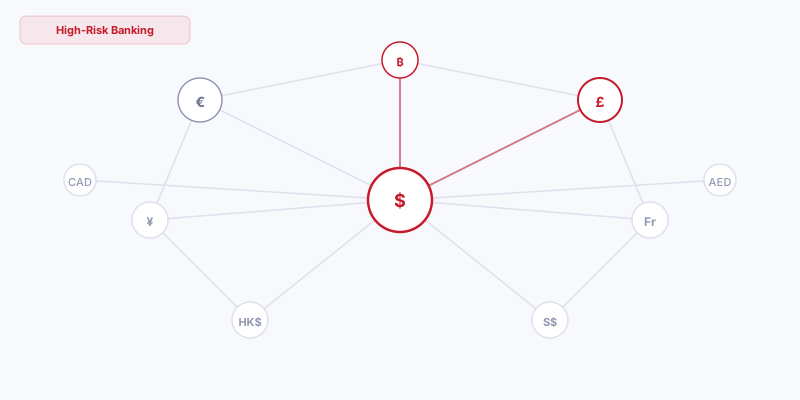
For businesses operating across multiple jurisdictions — iGaming operators collecting in EUR, GBP and USD simultaneously, crypto businesses converting between fiat currencies, or offshore holding structures repatriating dividends from subsidiary companies — the architecture of multi-currency banking is not a minor administrative question. It directly determines your FX costs, operational liquidity, regulatory compliance obligations, and your ability to actually receive and send money. Getting it wrong is expensive. Getting it right creates a genuine competitive advantage.
This guide covers the full spectrum: what different account types actually mean, how they interact with FX exposure, the regulatory constraints that apply, and how to structure accounts appropriately for complex international businesses.
Named IBANs vs Pooled Accounts: The Fundamental Distinction
The most consequential structural decision in multi-currency banking is whether you hold funds in named IBANs (dedicated account numbers assigned to your specific legal entity) or pooled accounts (shared infrastructure where your balance sits alongside other clients' funds within a single master account).
Named IBANs assign a unique IBAN to your entity in a specific currency and jurisdiction. The account number is yours exclusively. Inbound payments from third parties reference your IBAN directly; your funds are legally identifiable and segregated at the account level. For FCA-regulated Electronic Money Institutions, named IBANs issued to clients must comply with the Electronic Money Regulations 2011 (EMR 2011) and the FCA's safeguarding requirements under CASS 15 — funds received must be safeguarded in segregated accounts or covered by an insurance policy or guarantee. CCYFX issues named IBANs across EUR (SEPA), GBP (Faster Payments/CHAPS), and USD (Fedwire/CHIPS) jurisdictions, with the IBAN being issued in the client entity's own name.
Pooled accounts, by contrast, aggregate multiple clients' balances within a single master account. A virtual IBAN (vIBAN) routes inbound payments to the correct sub-ledger through a matching algorithm, but the underlying account belongs to the payment institution, not the client. This creates a legal distinction relevant to insolvency protection, correspondent bank acceptance, and counterparty credit assessment. Some enterprise clients — particularly financial institutions and regulated businesses — explicitly require named accounts in their own legal entity name for compliance reasons.
Currency Account Architecture for Offshore Structures
Internationally structured businesses — BVI holdings with operating subsidiaries in Malta, Gibraltar, or the Seychelles — face particular complexity. Each entity in the structure typically needs its own banking relationship, its own account set, and its own compliance documentation submitted to the account provider. The parent holding company and its trading subsidiaries are distinct legal entities; commingling funds between entities without a documented intercompany loan or dividend payment creates both tax risk (OECD BEPS Action 4 thin capitalisation provisions) and regulatory risk.
Best practice for offshore holding structures is to maintain at minimum: (a) a USD operating account for the holding entity, used to receive upstreamed dividends and hold central treasury liquidity; (b) local currency operating accounts for each subsidiary matched to its primary revenue currency; and (c) a EUR or GBP account at the holding entity level for repatriation to European banking partners. The number of distinct currency accounts required often surprises finance teams encountering multi-jurisdictional operations for the first time — a BVI holding structure with Malta and Gibraltar subsidiaries and an HK services company may require accounts in EUR, GBP, USD, and HKD across four separate legal entities.
SEPA and Non-SEPA Currency Account Considerations
Euro accounts split into two operationally distinct categories: SEPA accounts (connected to the Single Euro Payments Area infrastructure, enabling EUR credit transfers under the SEPA Credit Transfer scheme and the SCT Inst instant payment scheme) and non-SEPA EUR accounts (where EUR is held but transfers must route via SWIFT correspondent banking). For European-facing businesses, SEPA connectivity is non-negotiable — approximately 76% of EUR B2B payment volume in Europe now moves via SEPA Credit Transfer. An EUR account that cannot send or receive SEPA transfers has severely limited utility for day-to-day European commerce.
The EU Instant Payments Regulation (Regulation (EU) 2024/886), which came into force in April 2024, requires all EU Payment Service Providers offering standard EUR credit transfers to also offer SCT Inst by October 2025 (for eurozone PSPs) or April 2027 (for non-eurozone EU PSPs). This regulatory timeline means that the SEPA instant capability gap between legacy bank accounts and modern EMI-issued accounts is closing legislatively — but compliance timelines vary significantly by institution type and jurisdiction.
FX Conversion Architecture Within Multi-Currency Accounts
How and when currency conversion happens within a multi-currency account structure has a direct and significant impact on total FX cost. There are three principal models:
Auto-conversion at receipt: Inbound foreign currency payments are automatically converted to the account's base currency at the point of receipt. This is the default for most legacy business bank accounts — and it is where embedded FX margins are most easily obscured, because the conversion happens automatically without triggering an explicit FX transaction confirmation.
Hold in originating currency: Funds are received and held in the currency in which they arrive, without conversion. Conversion occurs only when explicitly instructed. This preserves the business's optionality to time conversions strategically, execute at better rates, or use the funds in their original currency for payments to counterparties in the same currency — eliminating the conversion entirely.
Scheduled batch conversion: Funds accumulate in the originating currency and convert at pre-agreed intervals (daily, weekly, or monthly) at a pre-negotiated rate or rate tier. This is the model used by many iGaming operators receiving player deposits in multiple currencies, where the sheer volume of small transactions makes individual rate negotiation impractical but scheduled batch conversion allows for meaningful rate improvement over retail auto-conversion.
CCYFX's multi-currency account architecture defaults to holding in originating currency, with conversion triggered explicitly by the client or via automated rules set at account level — preserving control and enabling the FX management strategies described elsewhere in our technical guides.
Compliance and KYC Requirements for Multi-Entity Account Structures
Each legal entity opening accounts with a regulated institution must pass through its own KYC and AML onboarding process. For offshore holding structures, this typically requires: corporate incorporation documents for each entity, certificate of good standing (updated annually in most jurisdictions), register of directors and shareholders, beneficial ownership register documentation compliant with the relevant jurisdiction's economic substance legislation, source of funds documentation for the group, and — for higher-risk sectors — a detailed business model description addressing the specific risk factors the institution's KYC framework identifies.
Under the UK's Money Laundering, Terrorist Financing and Transfer of Funds (Information on the Payer) Regulations 2017 (MLR 2017), as amended by the Money Laundering and Terrorist Financing (Amendment) (EU Exit) Regulations 2019, regulated firms must apply enhanced due diligence to customers presenting higher risk, including those from jurisdictions with strategic AML deficiencies (FATF grey or black list countries), Politically Exposed Persons, and customers operating in designated high-risk business sectors. iGaming, crypto, and offshore structures commonly trigger EDD requirements, which means the account opening process is materially more intensive than for standard commercial accounts.
Safeguarding and Client Money Protection
For UK FCA-regulated EMIs and Payment Institutions, client funds must be safeguarded under the EMR 2011 regulations. There are two permitted safeguarding methods: segregation (holding relevant funds in a dedicated account with a credit institution or investing in secure, liquid low-risk assets, separate from own funds) or insurance/guarantee (covering the relevant funds by a suitable insurance policy or guarantee from an authorised insurer or credit institution). Most FCA-regulated payment institutions use the segregation method, maintaining safeguarded client funds accounts with major UK credit institutions.
FSCS deposit protection (currently £85,000 per eligible depositor per institution) does not apply to funds held with EMIs or PIs — this is a critical distinction that corporate treasury teams should understand. In an insolvency event, safeguarded funds are ring-fenced and distributed to clients ahead of general creditors, but there is no government-backed guarantee scheme of the FSCS type. This makes the counterparty quality of the underlying safeguarding bank material to the risk assessment of holding large balances with any EMI or PI.
Building the Right Account Stack
The optimal multi-currency account architecture for an internationally structured business is rarely a single provider solution. WH typically advises clients to think in terms of layers: a primary operating account provider offering the broadest currency and jurisdiction coverage with named IBANs for each entity, a secondary provider for resilience and coverage of currencies or corridors the primary cannot support, and a legacy bank relationship maintained for specific requirements such as trade finance, guarantee issuance, or counterparty preference for bank-to-bank transfers.
CCYFX provides named IBAN accounts across EUR, GBP, USD, HKD, SGD, AED, and CAD, with SEPA and Faster Payments connectivity for EUR and GBP respectively. Our onboarding process is designed for complex structures, with a dedicated relationship manager managing the KYC process for multi-entity groups rather than routing each entity through a generic digital onboarding flow. Contact our team to discuss your specific structure and requirements.
CCYFX provides named multi-currency IBAN accounts for complex international structures including iGaming, crypto, offshore holdings and FX broker treasury. FCA-authorised EMI (FRN 987654).
Discuss Your Account Structure