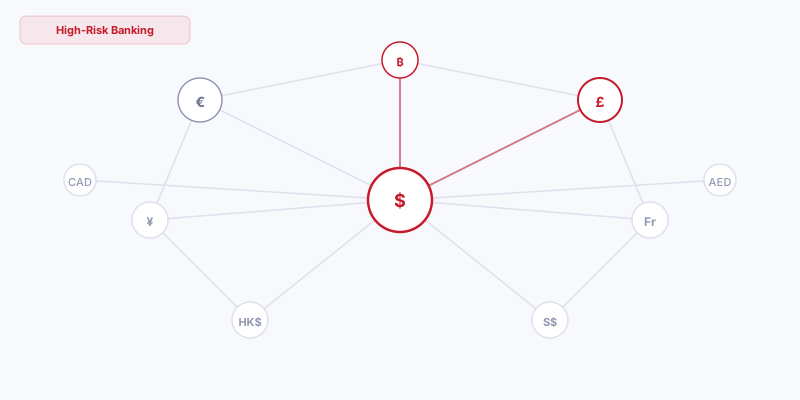
Single-provider dependency is the most common and most dangerous payment infrastructure mistake made by businesses in high-risk sectors. The logic for having a single payment provider feels compelling when accounts are hard to open: once you have a working account, why complicate things? The answer is that payment accounts in high-risk sectors are inherently fragile — subject to periodic compliance reviews, susceptible to sector-wide policy changes at the provider, and vulnerable to the provider's own regulatory or financial difficulties. A single account termination or suspension at the wrong moment can be existentially damaging for a business whose revenue depends on continuous payment processing capability. Building multiple banking relationships is not a luxury; it is a fundamental operational risk management requirement.
Understanding Concentration Risk
Concentration risk in banking infrastructure means the same thing it means in investment portfolios: over-reliance on a single counterparty creates an exposure where the counterparty's failure or decision to exit the relationship causes disproportionate harm. For high-risk businesses, the probability of any given payment provider deciding to exit the relationship — due to sector policy changes, regulatory pressure, internal risk appetite changes, or the provider's own financial difficulties — is materially higher than for businesses in mainstream sectors. This elevated probability means that diversification is not merely prudent but necessary for operational continuity.
The specific risks driving account termination in high-risk sectors include: sector-wide policy changes by the payment provider (a new board decision to exit all gambling or all crypto relationships); FCA or parent bank supervisory pressure on the provider about its high-risk client mix; changes in the provider's own risk ratings or correspondent banking relationships; and individual account reviews triggered by transaction monitoring alerts. None of these risk factors is within the business's control — even a perfectly compliant iGaming operator or crypto exchange can have its account terminated because the payment provider's risk appetite changes. The only effective mitigation is to ensure that termination of any single relationship does not threaten business continuity.
The Minimum Multi-Provider Architecture
The minimum resilient architecture for a high-risk business with meaningful payment volumes is: two independent payment providers for each major currency, with the two providers having different ultimate parent banking relationships (so that a single parent bank's de-risking decision does not simultaneously affect both). For a business operating in GBP and EUR: two GBP accounts at different specialist EMIs; two EUR accounts, with at least one being an EU-regulated provider for direct SEPA access; and the capacity to route all payment types (inbound, outbound, international) through each account independently.
The second account must be genuinely active — regularly used for some subset of transactions, with a current balance and a recent transaction history. A dormant backup account at a specialist EMI is at risk of being closed as inactive, reviewed as suspicious when suddenly activated after a long period of inactivity, or not being immediately operational when needed. Running 20-30% of normal payment volumes through the secondary account is sufficient to maintain it as an active relationship while not diluting the primary relationship to a level that reduces its utility.
Diversification Across Provider Types
Beyond holding multiple accounts of the same type, diversification across provider types adds further resilience. For an iGaming operator, this might mean: a specialist UK-regulated EMI for GBP and EUR operations; a Malta or Lithuania-regulated EMI for SEPA and EU-jurisdiction access; and a crypto on/off ramp capability for markets where traditional card and bank transfer payment methods face restrictions or have high failure rates. Each provider type has different risk exposures — UK regulatory risk versus EU regulatory risk; traditional payment rail risk versus crypto rail risk — and the combination reduces the probability that a single regulatory or commercial event disrupts all payment capability simultaneously.
Relationship Management Across Multiple Providers
Maintaining multiple payment relationships creates relationship management obligations. Each provider needs compliance updates, responses to information requests, and proactive communication about material business changes. This is not a burden to be resented — it is the cost of operational resilience, and the investment in relationship management across multiple providers is small relative to the cost of a business-critical payment disruption. Businesses should designate a relationship manager for each payment provider, establish a regular update cadence (at minimum quarterly for key providers), and maintain a compliance file for each relationship that is kept current.
When a business's compliance posture or business model changes — new markets, new products, changes in transaction volumes, changes in ownership or UBOs — all active payment providers should be notified proactively. A provider that discovers a material change to a client's business through transaction monitoring rather than from the client is a provider whose confidence in the relationship is immediately undermined. Proactive communication about changes is the single most effective way to maintain long-term relationship stability across multiple providers simultaneously.
CCYFX provides specialist banking infrastructure for complex businesses. UK, European & US IBANs, FX hedging, crypto on/off ramp, and global payouts to 180+ countries.
Speak to Our Team