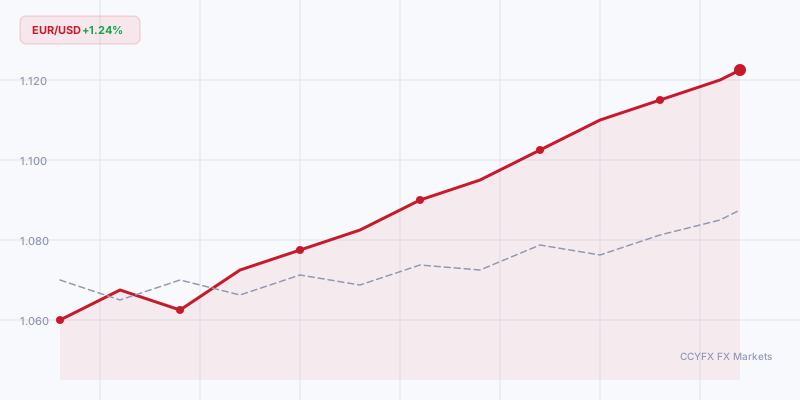
FX volatility in 2026 is structurally elevated relative to the 2015–2021 low-volatility era, and for reasons that are not going to resolve quickly. The simultaneous unwinding of decade-long carry positions (primarily JPY and CHF funding), continued central bank policy divergence across the G10, geopolitical fragmentation affecting trade flows, and increasingly correlated responses to risk events across asset classes — all contribute to an environment where multi-percent moves in major currency pairs are routine rather than exceptional.
For corporate treasury teams, elevated volatility has two practical implications: options are more expensive (reflecting the higher implied volatility priced in), and unhedged positions carry greater value-at-risk than in previous years. Understanding the specific volatility profile of the currency pairs most material to your business is the first step to calibrating an appropriate hedging response.
The CVIX and Broader Volatility Context
The Deutsche Bank Currency Volatility Index (CVIX) — a broad composite of 3-month implied volatility across G7 FX pairs — averaged approximately 6.1 in 2019–2021, spiked to 10.8 in 2022 (Russia/Ukraine, Fed tightening), settled to around 8.0 in 2023–2024, and currently reads approximately 8.5 in Q1 2026. This level is modestly above the 2010–2019 average of 7.2 but significantly below the 2008–2009 crisis peak of 15+.
The implication for option pricing: at CVIX 8.5 versus 6.1, a 3-month EUR/USD ATM straddle costs approximately 40% more in premium terms. Businesses that previously budgeted option costs based on 2019–2021 volatility levels will be underestimating current hedging costs if they rely heavily on options. Forward programs — where cost is not directly vol-sensitive — become relatively more attractive in elevated vol environments.
EUR/USD: Moderate Volatility, Clear Directional Drivers
3-month EUR/USD implied volatility: approximately 6.5%. The pair has well-defined fundamental drivers — Fed vs. ECB divergence, German fiscal impulse, US data — that make it amenable to directional hedging. Option costs are not excessive: a 3-month 1.13 EUR call costs approximately 0.55% of notional. Key vol events: FOMC meetings (March 18, May 6, June 17), ECB meetings, US CPI releases. Elevated one-day vol around these dates; calmer between.
GBP/USD: Above-Average Volatility, Political Sensitivity
3-month GBP/USD implied volatility: approximately 7.5%, above the G7 average. Sterling has chronically elevated vol reflecting UK-specific political risk premium (post-Brexit, post-Budget), lower liquidity than EUR/USD, and sensitivity to BoE communication. For businesses with material GBP exposure, options are notably more expensive than for EUR pairs. Collars are frequently preferable to vanilla puts given the option cost. Key vol events: UK CPI, OBR forecasts, BoE MPC meetings.
USD/JPY: The Highest-Risk G7 Pair in 2026
3-month USD/JPY implied volatility: approximately 9.5% — elevated, reflecting the BoJ policy normalisation risk discussed in the carry trade article. This is the pair where an unexpected policy move can generate 8–12% moves in days. Option markets price significant asymmetry: JPY calls (USD puts) are expensive relative to JPY puts, reflecting the market's fear of a JPY squeeze. For businesses with JPY exposure in either direction, the hedging cost reflects real uncertainty — and the cost of being unhedged if a BoJ surprise materialises is very high.
EM Pairs: Elevated and Skewed
- USD/BRL: 3M implied vol approximately 14%. Brazil's fiscal dynamics and political risk premium keep BRL vol structurally high. Forward market is liquid to 12 months.
- USD/MXN: 3M implied vol approximately 12.5%. "Nearshoring" trade flows and US-Mexico trade relationship uncertainties create notable vol. NDF not needed — MXN is fully deliverable.
- USD/ZAR: 3M implied vol approximately 13%. South Africa's political and fiscal dynamics plus commodity cycle sensitivity create persistent elevated vol.
- USD/TRY: 3M implied vol approximately 18-20%. Turkish lira remains in a structural depreciation trend, with extremely high carry that reflects genuine devaluation risk.
Volatility Term Structure: Near-Term vs. Long-Dated
One of the distinctive features of the 2026 volatility environment is that short-dated volatility (1-week, 1-month) is elevated relative to 6-12 month volatility — a flattish or inverted vol term structure. This reflects near-term event uncertainty (FOMC meetings, BoJ decisions) rather than long-run structural uncertainty. For corporate hedgers, this means:
- Short-dated options are expensive relative to historical norms — consider forwards instead for near-term committed exposures.
- Longer-dated options (6–12 months) offer better relative value — the vol premium per unit of time is lower, and the protection horizon is more appropriate for strategic business planning.
CCYFX provides specialist banking infrastructure for complex businesses including iGaming operators, crypto exchanges, FX brokers, and offshore structures. UK, European & US IBANs. T+0 settlement.
Speak to Our Team